Showing posts with label ELCER. Show all posts

Sunday, June 24, 2018

Women’s Ministry Seminar in Kazan

From June 8 to 12 a seminar on women’s ministry led by the husband and wife team of Gotthild and Erika Stein was held in Kazan. More than 20 women from various cities around Russia (Kamyshin, Cheboksary, Orenburg, Moscow, Samara, St. Petersburg, Ufa, Naberezhny Chelnov and Saratov) took part. There were also, of course, members from St. Catherine’s Lutheran in Kazan, as well as a participant from Vinnitsa (Ukraine). Her participation was an important sign of the unity of Evangelical Lutheran christians in Russia and Ukraine. Many have known each other for many years insofar as the tradition of women’s seminars has been preserved already for 15 years; four cycles of the “Life Stages” seminar have been held, and yet are constantly in demand. 

During the first day everyone got acquainted with one another and found a place to stay in the dormitory of the Roman Catholic congregation of the Holy Cross.
The seminar itself began on the second day with teachers Pastor Gotthilf and Erika Stein from Stuttgart. Pastor Stein is retired, and Erika leads the “Life Stages” Bible study in her retirement. Ruth Stubenitzky, the translator for the Novosaratovka Theological Seminary, prepared the materials and interpreted for the seminar.
The theme of the seminar was God’s blessing and was based on the Old Testament story of Jacob. For the whole seminar Erika led us through his life story. We met his parents (Isaac and Rebecca), his brother Esau, his wives Lila and Rachel, and his children, through whom God established the 12 tribes of Israel. Together with Jacob we felt both the joy of God’s blessing and reckoning for the deception of his father, felt banishment from home, saw the staircase to heaven on which the Lord Himself was standing and gave Jacob a new promise. We experienced many other twists and turns in Jacob’s life (from blessing to hopelessness, from hopelessness to new blessing) during the seminar. This happened thanks to the well-thought-out and heartfelt work of Erika Stein. She presented the whole Biblical story of Jacob in the memorable form of installations. Step by step together with Jacob we went along his path and learned to recognize God’s blessing running through our whole lives and remaining relevant even during the most difficult times. Erika used this example to show us that God knows our names and cares about every one of us, as He knew and cared for Jacob. Both during the seminar and during one-on-one discussions Erika attempted to show God’s limitless love for us, the heavens opened up for believers, and living faith in the Lord.
During the breaks between lessons and in the evening we walked around Kazan, a city we liked very much and which impressed us very much with the beauty of its streets, parks and buildings. On Sunday we took part in worship with Holy Communion at St. Catherine’s Lutheran, presided at by Pastor David Gorn with the sermon by Pastor Gotthild Stein. Many thanks are due to the hosts - the congregation members of St. Catherine’s, for the organization of the excursion around Kazan, for their work in organizing breaks during the seminar, and for their kindness and tireless care.
We thank the organizers of the seminar: the Dean of the Samara Deanery Olga Temirbulatova and the Dean of the Central Denery Elena Bondarenko. Their preparatory work ensured that the seminar could take place.
We are thankful to brothers and sisters in Gustav Adolph Worke foundation who provided support for the seminar. The Committee on Women’s Work for the foundation has already supported these seminars and other ministries for 15 years, including this year. This support has done much to assist women in the Evangelical Lutheran Church in European Russia.
Julia Vinogradova

Saturday, June 23, 2018

Guests from India

MoscowOn Pentecost, May 20, at Sts Peter and Paul Cathedral in Moscow there was a guest preacher – Rev. Dr. Christian Samurai, the ambassador for international relations for the Tamil Evangelical Lutheran Church of India.
He came to Moscow together with his wife and daughter at the invitation of the Evangelical Lutheran Church of European Russia. After worship there was a meeting of the congregation with Mr. Samurai. He spoke about the history of the beginnings of Christianity in India, tied with the name of St. Thomas. The guest spoke in detail about the problems of Indian Christians, which experience persecution because of their faith in a country where the majority of believers are Hindu and also emphasized that India and Russia have long-time friendly relations.
The reverend doctor prayed for the blessing of the Holy Spirit on the congregation and asked to pray for Christians in India. In conclusion Dr. Samurai signed copies of the May congregational newsletter with his photo.
A day earlier, on May 19, the guest from India took part in the Pentecost vigil service in the Cathedral of the Immaculate Conception of the Virgin Mary. The Lutheran congregation was also represented at this ecumenical service by the choir of the French-speaking congregation, Preacher Artis Petersons, Dean Elena Bondarenko, and also one other guest – Duverte Kaper (Netherlands).
Julia Vinogradova

New Pastors in the Kaliningrad Deanery

Gusev
The ordination of Natalia Chizhova and the installation as pastor in the Gusev region Alexei Chizhov were held on June 3 in the Salsburg church. This pastoral couple will serve 8 congregations in the regions. And they will both have responsibilities for pastoral care in the Carl Blume retirement home in the village of Zadorozhe.

Natalia and Alexei are graduates of the full-time program of the Novosaratovka Theological Seminary. During the past years – Alexei served as a pastor and Natalia as a deacon in congregations of the Evangelical Lutheran Church of Ukraine, a member of which Natalia had been since her youth, having grown up in the city of Poltava. Alexei is originally from Kazakhstan and came to the Theological Seminary after he and his family moved to the Volgograd region.
The ordination and installation were led by Archbishop Dietrich Brauer. He was assisted by Igor Ronge and other representatives of the region and guests, including Pastor Haye Osterwald, who for 12 years (1996-2008) served in the Kaliningrad deanery – first as pastor in Gusev and then – from 2002 – as the head of the deanery.
Pastor Elena Kurmyshova who had been serving as the pastor in Gusev will now begin her service in a different region of the deanery – the village of Bolshaya Polyana.

20 Years Step by Step

Gusev, Kaliningrad Oblast
“Twenty years – step by step.” That was the name of the celebratory program dedicated to the anniversary of the Diaconal center in Gusev in the Kaliningrad oblast, June 1-3. There were many guests from around the region, from Germany;  Archbishop Dietrich Brauer from Moscow was also in attendance.
“The Diaconal Center of Gusev” is an important social ministry project of the Kaliningrad deanery of the Evangelical Lutheran Church of European Russia. At present 5 trained deaconesses care for 23 patients – in general these are handicapped people without families.
The diaconal center was registered on June 1, 1998 and was one of the first such church projects in Russia. The founders were the Kaliningrad deanery and the "Stiftung Salzburger Аnstalt Gumbinnen" foundation from the German city of Bielefeld. The project began with educating women in this area of ministry through the courses lead by deaconess Erica Zeising from Bielefeld.
At that same time a group of people in the congregation took the initiative to make home visits to shut-ins together with Pastor Haye Osterwald and to provide for their basic health needs. At first these congregational members were volunteers;  from 2000 it was possible to pay them for their work. But the people who receive the help receive it for free.
Also from 1998 to 2017 lunches for children from needy families from the city were served. And during the summer holidays summer camps are held for single mothers who raise handicapped children.
The “Gusev Diaconal Center” has everything necessary for the care of those who are homebound – from bandages and pampers to creams and gloves as well as crutches and wheelchairs. Much of this has been brought to the center by volunteers from Germany – both individuals and as representatives of various organizations. Over these 20 years these people have supported the center's ministry.
For that reason at the anniversary celebrations there were over 130 people from various places. It is difficult to measure the degree to which the center's sponsors have helped those in need throughout these two decades.

Dean Igor Ronge

Working Visit of the Archbishop to St. Petersburg

On May 16 Archbishop Dietrich Brauer took part in the work of the 18th Petersburg International Legal Forum, where representatives of traditional religious groups debated the issue of the relationship between the state, society and religious organizations, including the question of the mechanics of state support of religious organizations. The moderator of the group was Sergei Gavrilov – the representative of the Duma committee on the development of civil society, societal and religious groups.
During his visit the Archbishop also visited one of the oldest members of our church, Edith Muetel, the author of two volumes of memoirs, the latter of which (“I Remember. From Petrograd to Petersburg through the Volga and Siberia”) is in Russian and was printed with the help of the St. Petersburg city government.
In addition he had meetings around other issues including the preparation of lay preachers for the Northwestern Deanery, restoration work at Petrikirche, the activities of the Theological Seminary and work on the liturgical handbook that is in the process of preparation.

Dedication of St. Mary's Church in Saratov

Archbishop Dietrich Brauer spoke about the church's dedication on May 13th and the events that took place preceding it in the following interview:

“The dedication of St. Mary's in Saratov is a long-awaited and happy event. 225 years have passed since the dedication of the first St. Mary's, which was located in the center of the city and was barbarically destroyed when it was blown up in 1971. The history of Lutherans in Saratov was interrupted for quite some time. Later the congregation was organized and began to meet in various places. On Sundays congregational members met in basements, and for big holidays they rented halls in order to fit in all those who wanted to attend.
Then the congregation began to build a new church; 25 years have passed since the congregation was reborn, and for more than 10 years now the new church has been under construction. The work was done only by fellow believers, both Russian Germans and others who show their care and concern. Both individuals and church groups have taken part in this good deed. The process of construction stretched out throughout the years, and even now the work isn't done, but the main work has been completed.
At the end of this stage we decided to dedicate the building in order that the congregation could feel that it was already in a fully-functioning church building. It can hold up to 200 people. Worship services are already held in the sanctuary, and there are many spaces for use by the Sunday school, for other ministries and even a small fireside room which creates a special atmosphere for meetings and discussions.
It was quite impressive that the Ambassador of the Federal Republic of Germany, Rüdiger von Fritsch, came to Saratov for the dedication of the building. Every year he visits one of the Russian regions, and he came to Saratov specially for the the dedication of the church and the celebratory worship.  What is more, he came not strictly as a government official, but as a preacher. Rüdiger von Fritsch is not only an ambassador, he is a theologian and is blessed as a preacher in the Lutheran Church. He has preached, for example, in the Bavarian Lutheran church when he was the ambassador in Poland and was happy to agree to give the sermon at the celebratory worship service in St. Mary's church. 
In his sermon the ambassador spoke about the New Covenant of God with man, the covenant based on the blood of Jesus Christ, His grace, His mercy. The preacher placed this imagine in the context of the event, in the context of Russian Lutherans and the Saratov congregation, which lost its building, lost hoped, but did not lose faith. This faith and the faithfulness of God, His faithfulness to the covenant that He once made with his people, saved and strengthened people during all times. “Today, during the dedication of the new St. Mary's church, the faithfulness of God to his covenant has been fully shown;” with these words the German ambassador brought his sermon to a close.
The participation of the ambassador of Germany in the events in Saratov drew attention not only to his person, but also to the problems of Russian Lutherans, to the needs of congregations. We are very thankful to Ambassador Rüdiger von Fritsch, for his attentiveness  to and interest in Russian Lutherans, for his active participation in the finding solutions to many important problems. In our days people frequently speak in the language of confrontation, of sanctions and threats. And the fact that a person can speak in a different language, heart to heart, the language of spirituality, the language of faith – it is very inspiring!
As he noted in his conversation with local journalists, the Ambassador’s main goal of this visit was to be present at the dedication and worship service, but many other events were also organized for him. He enjoyed visiting the city and oblast very much and spoke of his intention to visit again on a personal trip together with his wife.
It is a joy that three church buildings  in the region are being restored at once: the new St. Mary's, and two historical buildings in Zorkino and in Marx. In the former local businessman Karl Loor has led the efforts, while in Marx it is brothers Alexander and Viktor Schmidt.
Marx
During this visit we visited the wonderful, old church in Marx. It was a nice to see that the city itself is being transformed around the restored church – the embankment has been done, the territory was groomed – the city is awakening together with the church! The same thing happened in Zorkino. When from ruins a beautiful church was raised, everything around started to change, too. A new school and a hospital have appeared. People try to meet the standard of beauty that now surrounds them. I think that when the construction of St. Mary's in Saratov is finished, the industrial neighborhood where it is located will also begin to be transformed.”


Julia Vinogradova

25th Synod Assembly of the Evangelical Lutheran Church of European Russia

St. Petersburg
“To the thirsty I will give water as a gift from the spring.” (Rev. 21.6) – this verse is the watchword for 2018 and was also the theme of the ELCER synod assembly which took place March 20-22 at the Novosaratovka Theological Seminary (St. Petersburg). 32 delegates elected by their deaneries to represent them took part in this, the most authoritative legislative body of the ELCER, which meets biennially.
Synod President Olga Temirbulatova welcomed the delegates and guests, including Friedemann Eme from the Church of Saxony and the director of the Hannover office of Martin Luther Bund, Norbert Hintz; the latter has come many times to the synod assembly for fellowship with brothers and sisters and to participate in the work of the Synod. Before the assembly there was a conference of area deans during which each of them gave reports about the ministries of their regions.
Bishop Dietrich Brauer spoke in his report about the activities of the past two years, and in particular about the successful events dedicated to the 500th anniversary of the Reformation. Delegates accepted the report of the head of the ELCER administration, Viktor Weber, and confirmed the auditors' report for 2016-2017 and the budget for 2018-2019. The coordinator of women's ministries Elena Bondarenko, of youth work Vera Tkach and the coordinator of diaconal ministries Artis Petersons informed delegates about the work that has taken place since the last synod assembly and elected Vladislav Telegin to the office of children's ministries. Starting in March 2018 he began sending out materials for children's worship to the congregations of our Church.
The synod heard the report of the President of the Theological Seminary, Anton Tikhomirov, and supported the seminary with the following statement: “The synod assembly declares that the Seminary is a unique Russian-speaking educational institution and theological center for the entire post-Soviet context. Its continued existence is fundamentally important for our Church and for all the Churches of the Union of Evangelical Lutheran Churches.” The synod assembly expressed its willingness to support the Seminary in any way possible. Bradn Buerkle, the head of the “Equipping for Service” educational ministry, spoke with delegates about the seminars that have been held in congregations in Russia and the Union. All those in attendance received as a gift the new book of collected sermons by Archbishop Dietrich Brauer. The synod assembly came to a close with a worship service with Holy Communion on March 22nd at the seminary chapel.

“The Ninth Hour”

Yaroslavl
On March 15 Pastor Agris Pilsums, who serves the Lutheran congregations in Ilukste, Subate and Lasi (Latvia), drove his car to Yaroslavl and brought with him the diptych “The Ninth Hour” („Devītā stunda"), painted by his wife, Art History specialist Daiga Pilsuma.
The diptych will become the altar picture in Sts. Peter and Paul Church in Yaroslavl. Christ's Passion as portrayed in the paint fits in well with the rough, once-destroyed-and-now-being restored interior of the church. It reminds us both of death and God's victory over death.
Church council President Igor Fedder, lay preacher Artis Petersons, congregational Pastor Ivan Shirokov and Area Dean Elena Bondarenko were there to receive the painting. A celebration is being planned for this summer for the dedication of the painting.

Saturday, April 7, 2018

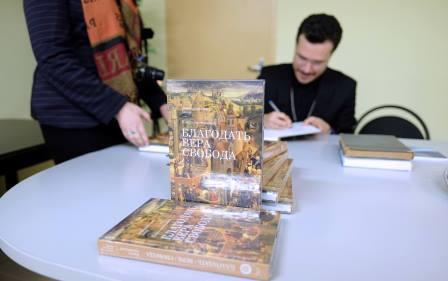
'Grace. Faith. Freedom.': Presentation of a Book of Sermons by Archbishop Dietrich Brauer

Moscow

On February 18th in the Sts Peter and Paul Cathedral in Moscow Archbishop Dietrich Brauer's 'Grace. Faith. Freedom.' book of sermons was presented.
The book is built around the church year – from Advent to to the period after Trinity including Harvest Festival and Reformation Sunday. The book includes sermons that the Archbishop gave both in Russia and in other countries. The book also has prayers for special holidays and is illustrated with paintings by Hans Memling and Rembrandt.
Martin Luther established the tradition of sermon books. Today, in the words of the Archbishop, these collections remain relevant for the Lutheran Church in Russia: “The Church exists not only in Moscow and St. Petersburg, but in very isolated regions. There are congregations with no pastor and only lay preachers or untrained leaders. Therefore it is very important to use the chance we have so that there can be materials, books, which could be used in case of need; sermon collections, therefore, can be of great assistance.”
“Grace. Faith. Freedom.” is meant not only for Lutherans: “I tried to make this collection of sermons as accessible as possible for a wide group of readers - not just for those who are our constant congregational members, but also for those who are getting acquainted with the Lutheran tradition for the first time,” the Archbishop said.
After the book presentation Dietrich Brauer answered questions from congregational members and guests at the cathedral. Answering the question about further plans for writing, the Archbishop said that he is working on his next book “Catechism.” At the end of the meeting the author signed his book, which was distributed freely to those who were in attendance.
Julia Vinogradov

A New Bell Rings Out in Ufa

Just before the beginning of Lent, on February 13, a bell was installed in the belltower of the Lutheran church of Ufa. As congregational pastor, Heinrich Minich, reported, the bell was custom ordered at the Shuvalov Brothers' Yaroslavl Bell Factory.
Lutheran bells have somewhat different characteristics than Orthodox bells. The weight of this bell is 150 kgs and was installed by congregational members with the help of special equipment. The bell will be on an automatic ringer and manual ringing will be unnecessary. The following words are etched on the outside of the bell: “the Lord is with us until the end of the age.”
The bell was purchased with the help of the “Ural” charitable foundation headed by the former president of Bashkortostan, Murtaza Gubaidullovich Rakhimov.
Sergey Rusakov

Congregational Anniversary Year Starts With Book Presentation

Saratov
On January 28th St. Mary's Evangelical Lutheran church in Saratov hosted a book presentation. O.Litsenberger, A. Deryugin and N. Kolomitsev co-authored a book about the Saratov congregation on its 250th anniversary... which will officially take place only in 2020; since historical documents give no exact date of the foundation of the congregation, this date is calculated based on the first time the congregation is referenced in external sources.
The book is entitled “St. Mary's Evangelical Lutheran Church in Saratov at the 250th Anniversary of its Founding.” This publication acts as a follow up to the first book about St. Mary's Lutheran, published 22 years ago, in 1995. It is targeted at historians and others for whom it is interesting to know about the Lutheran church in the city and its influence there throughout the years. The book covers the life of the congregation, its relationship with the government authorities, the difficult fate of those who ministered in the congregation in the 20th century, and the development of the congregation in our days.
The book presentation started the process of celebrating two other anniversaries related to the history of Saratov Lutherans. On October 6, 2018, 225 years will have passed since the dedication of the first St. Mary's church in the city, and on November 22 it will be 25 years since the congregation's rebirth. Unfortunately the first building lasted only 83 years
(1793-1876) and was seriously damaged in a fire. The second St Mary's arose 3 years later (1879-1970), but was destroyed during the time of state atheism. It was located on the central city street – German Street (now Kirov) and was built according to the plans of the world-famous architect from Berlin, Johann-Eduard Jakob Stahl.
The logo of the anniversary shows three crosses: the first is black-purple and symbolizes the tragic fate of the first building; the second is red and is a reminder of the sufferings of the period of repression, and the third is a white cross which is a symbol of the contemporary church building which is already 11 years old and the hope for long years of the the triumph of love, goodness and spiritual peace in Saratov and in the country as a whole. The appendixes to the book are also of great value – archival materials and rare photographs.

The President of the ELCR General Synod and Dean of the Saratov area Andrey Dzhamgarov, led the event. Elena Heydt, the representative of the publisher, the regional coordinator of the International Union of German Culture and the chair of the “National-Cultural Group of Russian Germans of the Marx region, personally congratulated those in attendance on the occasion of the anniversary and also read a congratulatory letter from the First Deputy President of the International Union of German Culture, Olga Martens.
Then the congregation and guests heard the letter from the main author of the two books, Professor Olga Litzenberger, Ph.D. “On this significant day I personally and all the authors of the book want to express to you, dear pastors, members of church councils and congregational members, our gratitude for your many years of irreproachable work. I congratulate all of you with the publication of this new book about the Saratov congregation.”

After this the co-authors of the book – church council member Alexander Deryugin and church council member, journalist and linguist Nikolai Kolomiytsev, spoke about how this publication was put together, and in particular drew the attention of readers to three very interesting chapters filled with abundant historical facts.
After this there was a ceremony thanking those who cooperated with the authors - each of the former of which were given a copy of the book and a certificate of thanks. Also a copy of the book was given to each of the two largest regional libraries.
Representatives of the government also were present at this event. Dmitry Konusov, the vice minister of internal affairs and civil society for the Saratov oblast, was in attendance. Elena Poznyakova, the head of the department of relations with cultural institutions for the Saratov oblast, also greeted the congregation and guests of the event.
Representatives of other Christian denominations in the region were also invited to the book presentation. The head priest of St. Clement Roman Catholic Church in Saratov, Andrey Slavik, gave a heartfelt congratulations to all in attendance on the occasion of the publication of the book and the double anniversary of the congregation.
After this those in attendance could ask questions of the authors and also receive signed copies. The day ended with a reception.

“Theatrical Sarepta”

Volgograd
The “Theatrical Sarepta” festival, which the Lutheran congregation helped organize and in which the congregation took part, was held on January 21-22. The ceremonial opening took place in the kirche and started with a celebratory concert of children's drama groups; locally-trained actors from Marx, Kamyshin and Volgograd presented their own original plays. For example the “Hoffnung” folk theater (led by Svetlana Gelber) put on a skit about Catherine the Great and the residents of the Sarepta Moravian Brotherhood colony which was founded near Tsaritsyno (now Volgograd) in the 18th century.


At the end of the festival a family drama group from the congregation, led by Nelly Tretyakova, put on a play that she had written - “A History of One Poem.” In this play the story revolves around an anonymous poem found in the congregation's porch; the actors showed how an intergenerational family (a grandmother, daughter, granddaughter and two grandsons) reacted to this text and the theme of forgiveness that is at its center. The grandmother helps the younger generation come to a true understanding of forgiveness. Special treats of the day included music by Nelly's grandchildren on the guitar and piano and her homemade traditional German “krebles.”


“The World is in Me, and I am in the World”

Krasny Yar
The congregations in Tolyatti and Samara held their annual children’s camp during the winter holidays January 3 to 8 in the village of Krasny Yar in the Samara oblast. The theme was chosen deliberately. Many children today ask questions about how faith in God can be integrated into everyday life and how to act so that this faith is spread.
Human life can be divided into, let's say, three social “spheres.”The first has a radius of one meter around the person - we'll call it “I myself.” The second – with a radius of three meters - is “I myself, my friends and relatives.” The radius of the third sphere is endless - “I myself and the world around me: people, animals, nature.”
For 5 days the kids thought about how God spreads His love through all these “spheres” and how we can reflect that, how we can influence the world for the better.

Tatyana Zhivodyorova

Thursday, March 1, 2018

Christmas 2017

Astana (Kazakhstan)
Grodno (Belarus)
Kazan
Krasnoyarsk
Lozovaya (Ukraine)
Lvov (Ukraine)
Moscow
Omsk
Rustaveli (Georgia)
St. Petersburg
Samara
Saratov
 Tibilisi (Georgia)
 Tomsk
Ulyanovsk
Volgograd (Sarepta)

Friday, December 29, 2017

Artistic Album of German Russian Heritage Published in the Year of the 500th Anniversary of the Reformation

Moscow
In the year of the 500th anniversary of the Reformation the International Union of German Culture (IUGC) prepared a unique artistic album “From Heaven Above..." about the history of the most important Lutheran symbols of Russia – active and abandoned kirchen. The album (1000 copies of which were printed) contains historic information, prose texts, rare architectural plans of buildings and contemporary photographs, as well as digital painting by Russian German artists especially created as part of an art lab.
“This year is marked by an event of worldwide significance – the whole world celebrates the 500th anniversary of the Reformation, which had enormous influence on the development of scientific thought, art, and faith of many people and cultures. The album published by the International Union of German Culture is more than just a project that presents the history of Lutheranism in Russia. It is also a large artistic and analytical work which is meant to save that integral part of the historical heritage of our country which is the Lutheran tradition of Germans of Russia,” noted Igor Barinov, the leader of the Federal Agency of ethnic affairs.
The publication is unique insofar as it presents a living reflection of Lutheran culture of our country; in addition to historical facts, it has real artistic value. The name of the album comes from a line in the poetry of Martin Luther: “From Heaven Above to Earth I Come...” - the poetry of a person whose theses caused upheaval in the Christian world.
“On the one hand we wanted to give a sign of respect to our ancestors who started to come to Russia already in Luther's lifetime and then, in the years of Catherine (the Great) II’s manifestos inviting Germans (1762-3) when Germans settled en masse in the Russian provinces and founded more than 75 Evangelical Lutheran colonies in the Volga region alone. On the other hand we wanted to tell our fellow citizens and European society about the rich history and tradition of Lutheranism in Russia,” said the album's publisher, the first vice-chair of IUGC, Olga Martens.
At the core of the album are the results of the work of the Art Lab of the Creative Union of German Russians, especially their expeditions to the Volga. In 2016 and 2017 painters created around 30 canvases with Lutheran cathedrals of Russia as their main subjects. Some of these historical monuments have been restored; others are abandoned, having been used in the Soviet period as grain bins, auto repair shops, clubhouses, swimming pools, barns... after that tragic page in the history of German Russians began in 1941 – deportations, forced labor, eternal exile.
Even in the most difficult circumstances of repression and homelessness Russian Germans were able to retain their ties with their religion. Faith helped many of them to survive the periods of deportation and repression. The Germans of Russia were always very pious and many families saved their families' Bible and hymn books. Even today a majority of Russian Germans are Protestant. This confessional commitment played and continues to play a big role in the preservation of German culture and identity.
“The Reformation was not only a religious event. It prompted man to think about his relationship with God as well as his place in human society. The Reformation began with one person and many others were caught up in it. We are heirs of the Reformation whether we are members of Lutheran churches or not. In these kirchen the main thing that happened was that there was a Reformation of the heart. In these building songs of praise were song to the One who gives life. Here people found inspiration for transforming and reforming life around them,” said ELCR Archbishop Dietrich Brauer in his forward to the album.
The exhibition and album are intended to acquaint readers with the history of Russian Germans through the prism of the Reformation and the confessional agency, Lutheran and German architecture. The album includes never before published historical documents – architectural plans and historical information about Lutheran churches and congregations in the capitals and in large cities as well as in the areas of German settlement on the Volga. The chronology of development of Lutheranism in Russia and these historical texts about church buildings were written by the most qualified specialist on the history of Lutheranism in our country, Prof. Olga Litsenberger, Ph.D.
The presentation of the first paintings from the exhibition of German Russian artists entitled “From Heaven Above....” first took place in the Temple of Jesus Christ in the village of Zorkino (Zurich) on August 28, 2016 – the 75th anniversary of the deportation of Soviet Germans. Then the pictures were sent to the Sts Peter and Paul Cathedral in Moscow as part of the Forum of Germans of Russia in October 2016.
The ceremonial presentation of the album and the mobile exhibition took place as part of the 500th Anniversary of the Reformation events in the city church of Bayreuth (Bavaria, Germany) on May 22, 2017. Visitors will be able to see the exhibition in other German cities as well – in Augsburg and cities of Saxony-Anhalt, after which the exhibition and album will be presented in various places in Moscow.

Original text from the site: www.rusdeutsch.ru

Reformation Conference in Moscow

On May 30-31 an ecumenical conference dedicated to the 500th anniversary of the Reformation was held at St. Peter and Paul Cathedral in Moscow. Representatives of the Moscow government, Orthodox, Catholic and Protestant groups spoke at the opening event.
“This anniversary year challenges us to cleanse and to heal memories and to restore Christian unity in accordance with the Gospel,” said the Papal Nuncio in the Russian Federation, Archbishop Celestino Migliore. He reminded everyone that Christianity is the only world religion that has an ecumenical movement. According to him among Christian denominations “consensus is growing regarding understanding Christian unity as reconciled diversity.”
The Secretary of the division for external church relations of the Moscow Patriarchate Archpriest Stephan (Igumenov) greeted Lutherans in the name of the Russian Orthodox Church. Speaking of the Reformation he noted that “these events far away from Russia” all the same during all these 500 years have influenced our country. He mentioned that Lutherans have been in Russia more than 400 years and have a “dignified place in the multicolored palate” of the country and wished the “relatively small, but vivid” Lutheran congregation prosperity.
During the concert dedicated to the opening of the conference works by Bach, Mozart, Frank and Barber were played by the chamber orchestra “Instrumental Cappela” and the «Soli Deo Gloria» chamber orchestra of organ and soloists directed by Oleg Romanenko. A special treat of the concert was the performance of the III and IV parts of Symphony #5, the “Reformation” symphony of F. Mendellsohn-Bartholdy, which was played in Sts. Peter and Paul for the first time.
”Today all those church leaders and representatives of government structures mentioned that the Reformation taught us a lot. It taught us to value the common root that is the source of our hope, our faith in Jesus Christ” – said Archbishop Dietrich Brauer of the Evangelical Lutheran Church in summing up the first day of the conference. “We are to be reconciled with one another, to go together along the path of peace and harmony with those people who represent various peoples, various convictions. We are all united by the One who invites us to follow Him, our one common Lord.”
During the second day of the work of the conference there were a number of papers dedicated to the heritage of the Reformation. ELC Seminary President Anton Tikhomirov spoke about Protestantism in Russian poetry. Pastor Bradn Buerkle's theme was the canonicty of the Evangelical Lutheran Church of Russia. Participants heard from Ulrich Heckel of Tubingen University about Martin Luther's understanding of the Church in an ecumenical context.
The historian Pavel Gnilorybov presented his book “Five Centuries of Moscow Lutherans.” This book about the history of the founding and development of the Lutheran congregation in Moscow came out specially for the Reformation anniversary year. The book follows the lives of Protestants in the Russian capital; in its pages – famous teachers and pastors, philanthropists and patrons, the main addresses of Moscow Lutherans, and all the ups and downs of the relationship between the Evangelical Lutheran Church and the state. The publication is illustrated by photographs and by a series of 12 graphic works by the famous artist Andrey Sergunkin.


ELCR General Synod Elects a New President

Moscow
Archbishop Dietrich Brauer, in his sermon at the opening worship service of the Fifth General synod of the Evangelical Lutheran Church of Russia, spoke about his recent experience at the worldwide LWF gathering: “The influence of the Reformation is not limited to only European countries. The large gathering of the Lutheran World Federation was held in May of this year in Africa, in Namibia.  The entire host country was caught up in great joy - the president of the country – a Lutheran – organized a warm welcome for guests. On one of the days there were testimonies given by ministers of the church from various regions. Delegate Vera Tkach told the story of St. Mary Lutheran Church in the Petrograd region of St. Petersburg. In the years of the blockade the wooden church was disassembled and used for firewood to warm people's homes. In this way the church continued to serve people. Everything changed a century ago and this century left scars. Today, though, we are traveling on the road to His coming kingdom, trusting our Lord.”
This report helped give context to those gathered in Moscow for the General Assembly. 20 delegates, elected to 6-year terms by local and regional leaders in the Evangelical Lutheran Church in European Russia (ELCER) and the Evangelical Lutheran Church of the Urals, Siberia and Far East (ELCUSFE), took part in the event that included: the Archbishop's report, the vice-president's report from Tatyana Muramtseva and the report of the president of the Theological Seminary, Anton Tikhomirov.
Maria Khudenko and Viktor Weber spoke about the results of the new state registration of the church's constitution; the process has been completed and the Church should receive the confirmation documentation soon.
A second, no less important aspect of the meeting was the election of a new president. Two years ago Waldemar Bentzel was elected president, but he moved to Germany for a new place of service; in the meantime his responsibilities were passed on to Tatytana Muramtseva, the vice-president. The Dean of the Saratov Deanery of the ELCER, Andrey Dzhamgarov, was elected as the new president, with Dean of the Central Deanery of ELCUSFE, Vladimir Vinogradov, elected vice-president.
The audit commission was also elected: Elena Lobova from Omsk, Olga Smykova from St. Petersburg, and Lidya Reichert from Samara.
At the prayer service at the conclusion of this most authoritative meeting of Russian Lutherans Archbishop Brauer blessed Andrey and Vladimir in their new ministries.