Showing posts with label Dietrich Brauer. Show all posts

Saturday, June 23, 2018

New Pastors in the Kaliningrad Deanery

Gusev
The ordination of Natalia Chizhova and the installation as pastor in the Gusev region Alexei Chizhov were held on June 3 in the Salsburg church. This pastoral couple will serve 8 congregations in the regions. And they will both have responsibilities for pastoral care in the Carl Blume retirement home in the village of Zadorozhe.

Natalia and Alexei are graduates of the full-time program of the Novosaratovka Theological Seminary. During the past years – Alexei served as a pastor and Natalia as a deacon in congregations of the Evangelical Lutheran Church of Ukraine, a member of which Natalia had been since her youth, having grown up in the city of Poltava. Alexei is originally from Kazakhstan and came to the Theological Seminary after he and his family moved to the Volgograd region.
The ordination and installation were led by Archbishop Dietrich Brauer. He was assisted by Igor Ronge and other representatives of the region and guests, including Pastor Haye Osterwald, who for 12 years (1996-2008) served in the Kaliningrad deanery – first as pastor in Gusev and then – from 2002 – as the head of the deanery.
Pastor Elena Kurmyshova who had been serving as the pastor in Gusev will now begin her service in a different region of the deanery – the village of Bolshaya Polyana.

Seminar for Graduates

Moscow
On June 3 to 5 those seminary graduates who recently passed their final exams were gathered together at Sts Peter and Paul cathedral in Moscow for a seminar.
Artis Petersons (Moscow), Nikolai Deminov (Sol-Iletsk), Valentin Nikolaenko and Alexei Kolosvo (St. Petersburg) in conversation directed by the seminary leadership (President Anton Tikhomirov) and dean of the Central Deanery, Elena Bondarenko shared with one another their experience of studies and practical ministry, took part in the worship in the cathedral, and listened to Seminary President Anton Tikhomirov's lectures on homiletics, as well as met ELC Archbishop Dietrich Brauer.

While the internship of participants of the seminar from St. Petersburg is just beginning and for Nikolai Demonov it will continue, Artis Petersons passed his colloquium with very high marks and received his long-awaited seminary diploma.
A pleasant addition to the seminar's program was a visit to the Catholic Institute of St. Thomas and discussions with its rector, Father Stephan Lipke, as well as time spent together in fellowship and walking around the city with one another.


Working Visit of the Archbishop to St. Petersburg

On May 16 Archbishop Dietrich Brauer took part in the work of the 18th Petersburg International Legal Forum, where representatives of traditional religious groups debated the issue of the relationship between the state, society and religious organizations, including the question of the mechanics of state support of religious organizations. The moderator of the group was Sergei Gavrilov – the representative of the Duma committee on the development of civil society, societal and religious groups.
During his visit the Archbishop also visited one of the oldest members of our church, Edith Muetel, the author of two volumes of memoirs, the latter of which (“I Remember. From Petrograd to Petersburg through the Volga and Siberia”) is in Russian and was printed with the help of the St. Petersburg city government.
In addition he had meetings around other issues including the preparation of lay preachers for the Northwestern Deanery, restoration work at Petrikirche, the activities of the Theological Seminary and work on the liturgical handbook that is in the process of preparation.

Dedication of St. Mary's Church in Saratov

Archbishop Dietrich Brauer spoke about the church's dedication on May 13th and the events that took place preceding it in the following interview:

“The dedication of St. Mary's in Saratov is a long-awaited and happy event. 225 years have passed since the dedication of the first St. Mary's, which was located in the center of the city and was barbarically destroyed when it was blown up in 1971. The history of Lutherans in Saratov was interrupted for quite some time. Later the congregation was organized and began to meet in various places. On Sundays congregational members met in basements, and for big holidays they rented halls in order to fit in all those who wanted to attend.
Then the congregation began to build a new church; 25 years have passed since the congregation was reborn, and for more than 10 years now the new church has been under construction. The work was done only by fellow believers, both Russian Germans and others who show their care and concern. Both individuals and church groups have taken part in this good deed. The process of construction stretched out throughout the years, and even now the work isn't done, but the main work has been completed.
At the end of this stage we decided to dedicate the building in order that the congregation could feel that it was already in a fully-functioning church building. It can hold up to 200 people. Worship services are already held in the sanctuary, and there are many spaces for use by the Sunday school, for other ministries and even a small fireside room which creates a special atmosphere for meetings and discussions.
It was quite impressive that the Ambassador of the Federal Republic of Germany, Rüdiger von Fritsch, came to Saratov for the dedication of the building. Every year he visits one of the Russian regions, and he came to Saratov specially for the the dedication of the church and the celebratory worship.  What is more, he came not strictly as a government official, but as a preacher. Rüdiger von Fritsch is not only an ambassador, he is a theologian and is blessed as a preacher in the Lutheran Church. He has preached, for example, in the Bavarian Lutheran church when he was the ambassador in Poland and was happy to agree to give the sermon at the celebratory worship service in St. Mary's church. 
In his sermon the ambassador spoke about the New Covenant of God with man, the covenant based on the blood of Jesus Christ, His grace, His mercy. The preacher placed this imagine in the context of the event, in the context of Russian Lutherans and the Saratov congregation, which lost its building, lost hoped, but did not lose faith. This faith and the faithfulness of God, His faithfulness to the covenant that He once made with his people, saved and strengthened people during all times. “Today, during the dedication of the new St. Mary's church, the faithfulness of God to his covenant has been fully shown;” with these words the German ambassador brought his sermon to a close.
The participation of the ambassador of Germany in the events in Saratov drew attention not only to his person, but also to the problems of Russian Lutherans, to the needs of congregations. We are very thankful to Ambassador Rüdiger von Fritsch, for his attentiveness  to and interest in Russian Lutherans, for his active participation in the finding solutions to many important problems. In our days people frequently speak in the language of confrontation, of sanctions and threats. And the fact that a person can speak in a different language, heart to heart, the language of spirituality, the language of faith – it is very inspiring!
As he noted in his conversation with local journalists, the Ambassador’s main goal of this visit was to be present at the dedication and worship service, but many other events were also organized for him. He enjoyed visiting the city and oblast very much and spoke of his intention to visit again on a personal trip together with his wife.
It is a joy that three church buildings  in the region are being restored at once: the new St. Mary's, and two historical buildings in Zorkino and in Marx. In the former local businessman Karl Loor has led the efforts, while in Marx it is brothers Alexander and Viktor Schmidt.
Marx
During this visit we visited the wonderful, old church in Marx. It was a nice to see that the city itself is being transformed around the restored church – the embankment has been done, the territory was groomed – the city is awakening together with the church! The same thing happened in Zorkino. When from ruins a beautiful church was raised, everything around started to change, too. A new school and a hospital have appeared. People try to meet the standard of beauty that now surrounds them. I think that when the construction of St. Mary's in Saratov is finished, the industrial neighborhood where it is located will also begin to be transformed.”


Julia Vinogradova

“The Theology and Poetry of Dietrich Bonhoeffer”

Moscow
On April 15th Sts. Peter and Paul Cathedral in Moscow hosted a conference dedicated to the legacy of the the 20th century martyr, Lutheran pastor Dietrich Bonhoeffer.
“The life of Bonhoeffer is one of testimony and martyrdom;” with these words the Archbishop of the Evangelical Lutheran Church, Dietrich Brauer, opened the conference. Bonhoeffer ”looked straight into the eye of the very difficult question what it means to be a Christian, what it means to follow Christ, in an inhumane environment, in a totalitarian state. He clearly and without fear point out to his Church the threats that faced her.” As a pastor he called Christians to “wake up, come a live, grow up, and the Church to stop sleeping and keeping silence, to stop being self-interested.” Bonhoeffer needed to remind his congregation members that the Church “cannot be the church of Luther or the Church of the German people. It belongs to Christ;” Bonhoeffer himself became a “living sermon,” the Archbishop said.

He also touched on the theme of “religionless Christianity” that is found in Bonhoeffer. “The Christian faith is not the same as the Christian religion or worldview. A sermon is not a pious template. It should be ‘religionless,’ accessible, understandable.... A person becomes a Christian not through a religious ritual but by taking part in the sufferings of God in everyday life. That is what metanoia is, not to think first of all about your own troubles, problems, sins, and fears but to allow yourself to be drawn to the path of Jesus Christ...” the Archbishop said referencing the memorable words of the martyred pastor.
«Religionless Christianity” was the central theme of the conference, with two author theologians, Professor Svetlana Konacheva from the Russian State Humanitarian University and President of the Novosartavoka Theological Seminary, Dr. Anton Tikhomirov also speaking on the theme. Tikhomirov spoke about Bonhoeffer's poetry as a place where he sought a new language for “religionless” Christianity.

based on the article by Yulia Zaitseva, www.blagovest-info.ru.

25th Synod Assembly of the Evangelical Lutheran Church of European Russia

St. Petersburg
“To the thirsty I will give water as a gift from the spring.” (Rev. 21.6) – this verse is the watchword for 2018 and was also the theme of the ELCER synod assembly which took place March 20-22 at the Novosaratovka Theological Seminary (St. Petersburg). 32 delegates elected by their deaneries to represent them took part in this, the most authoritative legislative body of the ELCER, which meets biennially.
Synod President Olga Temirbulatova welcomed the delegates and guests, including Friedemann Eme from the Church of Saxony and the director of the Hannover office of Martin Luther Bund, Norbert Hintz; the latter has come many times to the synod assembly for fellowship with brothers and sisters and to participate in the work of the Synod. Before the assembly there was a conference of area deans during which each of them gave reports about the ministries of their regions.
Bishop Dietrich Brauer spoke in his report about the activities of the past two years, and in particular about the successful events dedicated to the 500th anniversary of the Reformation. Delegates accepted the report of the head of the ELCER administration, Viktor Weber, and confirmed the auditors' report for 2016-2017 and the budget for 2018-2019. The coordinator of women's ministries Elena Bondarenko, of youth work Vera Tkach and the coordinator of diaconal ministries Artis Petersons informed delegates about the work that has taken place since the last synod assembly and elected Vladislav Telegin to the office of children's ministries. Starting in March 2018 he began sending out materials for children's worship to the congregations of our Church.
The synod heard the report of the President of the Theological Seminary, Anton Tikhomirov, and supported the seminary with the following statement: “The synod assembly declares that the Seminary is a unique Russian-speaking educational institution and theological center for the entire post-Soviet context. Its continued existence is fundamentally important for our Church and for all the Churches of the Union of Evangelical Lutheran Churches.” The synod assembly expressed its willingness to support the Seminary in any way possible. Bradn Buerkle, the head of the “Equipping for Service” educational ministry, spoke with delegates about the seminars that have been held in congregations in Russia and the Union. All those in attendance received as a gift the new book of collected sermons by Archbishop Dietrich Brauer. The synod assembly came to a close with a worship service with Holy Communion on March 22nd at the seminary chapel.

Saturday, April 7, 2018

Meeting of the General Consistory

St. Petersburg
In the last days of February the General Consistory (church council) of the Evangelical Lutheran Church in Russia (ELCR) met for the first time since the registration of the new constitution of the church in June of 2017.
Now all the members of the administration of the Church have the right to vote: Archbishop Dietrich Brauer, his deputy Vladimir Provorov, the Bishop of ELCUSFE Alexander Scheiermann, the President of the General Synod Andrey Dzhamgarov, his deputy Vladimir Vinogradov, the administrator of the Archbishop’s office, Maria Khudenko, Seminary President Anton Tikhomirov, the head of the ELCER administration, Viktor Weber, and the administrator of ELCUSFE, Tatyana Muramtseva.
On February 27 a working group met to discuss the church’s bylaws. The previous edition of these rules dates back to 1999 and needs to be updated. The Archbishop, the head of the administrations of ELCER and ELCUSFE, and the Seminary President were part of that group; they were joined by Bishop Scheiermann as well. They will need to meet twice more in order to finish the text and present it to the General Synod for approval. 
On February 28th the meeting of the General Consistory began; two guest from the LWFwere present - the director of the department of mission and development Rev. Dr. Fidon Mwombeki and the director of the European Department, Rev. Dr Ireneusz Lukas - and Dirk Stelter from the Evangelical Church in Germany. 
In the second half of the day the guests went with Seminary President Anton Tikhomirov to Novosaratovka, where a seminar for extension students was taking place. 
Members of the General Consistory came to the following decision about the LWF: it is important to come to another way of approaching membership insofar as membership as a whole Union of Evangelical Lutheran Churches no longer meets the expectations of the participating churches. 
By Easter 2018 Bradn Buerkle, head of the “Equipping for Service” educational project, will prepare the full text of a new liturgical book with the goal of preparing a printed version of the text by the General Synod in 2019. 
As with every meeting of the General Consistory reports were given by the Churches, by the Theological Seminary and the “Equipping…”  project. The auditors’ commision report was also given. Decisions were made aimed at increasing the effectiveness of the Church’s ministries.
The next meeting of the  General Consistory will be in October-November 2018. 

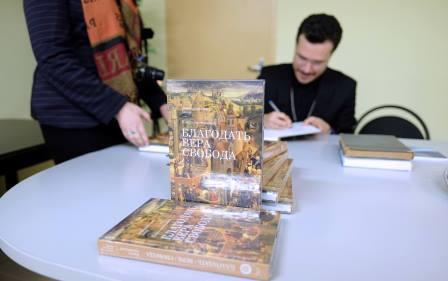
'Grace. Faith. Freedom.': Presentation of a Book of Sermons by Archbishop Dietrich Brauer

Moscow

On February 18th in the Sts Peter and Paul Cathedral in Moscow Archbishop Dietrich Brauer's 'Grace. Faith. Freedom.' book of sermons was presented.
The book is built around the church year – from Advent to to the period after Trinity including Harvest Festival and Reformation Sunday. The book includes sermons that the Archbishop gave both in Russia and in other countries. The book also has prayers for special holidays and is illustrated with paintings by Hans Memling and Rembrandt.
Martin Luther established the tradition of sermon books. Today, in the words of the Archbishop, these collections remain relevant for the Lutheran Church in Russia: “The Church exists not only in Moscow and St. Petersburg, but in very isolated regions. There are congregations with no pastor and only lay preachers or untrained leaders. Therefore it is very important to use the chance we have so that there can be materials, books, which could be used in case of need; sermon collections, therefore, can be of great assistance.”
“Grace. Faith. Freedom.” is meant not only for Lutherans: “I tried to make this collection of sermons as accessible as possible for a wide group of readers - not just for those who are our constant congregational members, but also for those who are getting acquainted with the Lutheran tradition for the first time,” the Archbishop said.
After the book presentation Dietrich Brauer answered questions from congregational members and guests at the cathedral. Answering the question about further plans for writing, the Archbishop said that he is working on his next book “Catechism.” At the end of the meeting the author signed his book, which was distributed freely to those who were in attendance.
Julia Vinogradov

The Sources of Faith of the Evangelical Lutheran Church in Russia and Kazakhstan

Hamburg
From January 12 to 14 a conference of the Gustav Adolf Werk was held on the theme “The sources of faith of the Evangelical Lutheran Church in Russia and Kazakhstan.” Among those attending were the President of the organization, Gabriele Wulz, General Secretary Enno Haaks, and the head of the organization in northern Germany (former Area Dean in Kaliningrad), Heye Osterwald. Archbishop Dietrich Brauer of the Evangelical Lutheran Church in Russia gave a paper about the history and contemporary situation of the Lutheran Church in Russia. In particular he emphasized the way the events of the Reformation anniversary were organized with an ecumenical spirit and in constructive cooperation with government authorities.

The conference concluded with Sunday worship at the Church of the Cross, where Archbishop Brauer gave the sermon.

Friday, December 29, 2017

ELCR General Synod Elects a New President

Moscow
Archbishop Dietrich Brauer, in his sermon at the opening worship service of the Fifth General synod of the Evangelical Lutheran Church of Russia, spoke about his recent experience at the worldwide LWF gathering: “The influence of the Reformation is not limited to only European countries. The large gathering of the Lutheran World Federation was held in May of this year in Africa, in Namibia.  The entire host country was caught up in great joy - the president of the country – a Lutheran – organized a warm welcome for guests. On one of the days there were testimonies given by ministers of the church from various regions. Delegate Vera Tkach told the story of St. Mary Lutheran Church in the Petrograd region of St. Petersburg. In the years of the blockade the wooden church was disassembled and used for firewood to warm people's homes. In this way the church continued to serve people. Everything changed a century ago and this century left scars. Today, though, we are traveling on the road to His coming kingdom, trusting our Lord.”
This report helped give context to those gathered in Moscow for the General Assembly. 20 delegates, elected to 6-year terms by local and regional leaders in the Evangelical Lutheran Church in European Russia (ELCER) and the Evangelical Lutheran Church of the Urals, Siberia and Far East (ELCUSFE), took part in the event that included: the Archbishop's report, the vice-president's report from Tatyana Muramtseva and the report of the president of the Theological Seminary, Anton Tikhomirov.
Maria Khudenko and Viktor Weber spoke about the results of the new state registration of the church's constitution; the process has been completed and the Church should receive the confirmation documentation soon.
A second, no less important aspect of the meeting was the election of a new president. Two years ago Waldemar Bentzel was elected president, but he moved to Germany for a new place of service; in the meantime his responsibilities were passed on to Tatytana Muramtseva, the vice-president. The Dean of the Saratov Deanery of the ELCER, Andrey Dzhamgarov, was elected as the new president, with Dean of the Central Deanery of ELCUSFE, Vladimir Vinogradov, elected vice-president.
The audit commission was also elected: Elena Lobova from Omsk, Olga Smykova from St. Petersburg, and Lidya Reichert from Samara.
At the prayer service at the conclusion of this most authoritative meeting of Russian Lutherans Archbishop Brauer blessed Andrey and Vladimir in their new ministries.


Thursday, December 14, 2017

Opening of the Year of the Reformation in Russia

Moscow
On March 22 in the “President Hotel” in Moscow, the “Year of the Reformation” officially got its start. While the anniversary itself will be celebrated on October 31, celebrations will take place all year long and in many various places around the church. These events were “opened” on a national stage at this gathering, attended by representatives of traditional Christian denominations, state representatives, diplomats, and journalists. The Archbishop of the Evangelical Lutheran Church of Russia, Dietrich Brauer, welcomed the guests.
In his speech he underlined the importance of the contribution of Lutherans to the social, cultural, scientific and educational spheres of our country. The Archbishop suggested that everyone consider the fruits of the Reformation as a historical phenomenon. “It is important to remember that Lutherans in the Russian state were not, in contrast to many countries of Eastern Europe, isolated, but took an active part in the development of social-political life.” “Of course the exception to this rule under the monarchy were the peasant farmers who were invited to Russia by the tsaritsa who grew up as a Lutheran, Catherine II (the Great). The official civil head of the Evangelical Lutheran Church of the Russian Empire was the Emperor (c.f., Code of Laws of the Russian Empire, 1832). Many leading Russians were Lutherans, including the Briullov brothers, Peter Faberge, Barclay de Tolly, Anton Delvig, Vitus Bering, Vladimir Dal, Iva Kruzenshtern, Sergei Witte. Lutheran churches to this day help make the central streets of Russian cities look beautiful. And despite all the difficulties and occasional repressions of Lutherans during troubled times, Lutherans always remained faithful to their homeland and deeply desired to work for its good. Christian exterior mission was for the most part limited to charity work, diaconal work as an expression of neighbor love. Thanks to many unique church-society projects the Lutheran Church has been able to successful move between confessional lines.”


Others who spoke supported this line of thinking. They included the journalist and historian Nikolai Svanidze, the former Minister of Culture Michael Shvydka, the representative of the International Union of German Culture Olga Martens, who particularly made note of the contributions of Lutheran pastors throughout history. Among the guests were deans and pastors of the Evangelical Lutheran Church in Russia who made the trip to Moscow specially for this event. The “Soli Deo Gloria" choir led by Oleg Romanenko contributed to the event by performing important Reformation-related songs – Mendelssohn's Reformation Cantata and Handel's “Alleluia” chorus.

Prayer for Christian Unity in the Lutheran Cathedral

Moscow
On January 24 in St. Peter and Paul's Cathedral of the Evangelical Lutheran Church in European Russia there was a worship service that united Christian congregations of various denominations from around the city. Participants came from Lutheran, Roman Catholic, Orthodox, Armenian, Baptist, Pentecostal and Adventist congregations.
In his greeting Archbishop of the Evangelical Lutheran Church in Russia Dietrich Brauer said: “Dear brothers and sisters! Five hundred years ago, the Reformation began. Martin Luther prompted the church to reform so that it would be able to fulfil the Great Commission given by Jesus Christ – to preach the Gospel to the world for the reconciliation of humankind with God. However, peace with God is tied inextricably with peace between people. A person acquires faith in God, becoming a child of God without any merits of their own, solely by grace. Therefore a believer cannot fail to see in a fellow Christian a brother or a sister. A Christian cannot but mourn about the division of the Church and to strive to attain unity. The ministry of reconciliation about which the Word of God is talking so clearly today is our common ministry. It takes place under the sign of the Cross. The Cross of Christ is the eternal sign of reconciliation between God and humankind. But the cross is also an eternal call to repentance. We really have nothing more to quarrel over when we are engaged in a ministry together. For the life of a Christian is the ministry of reconciliation. Today, dear brothers and sisters, I am praying to God to bless each of us to engage in this ministry of reconciliation in the name of Jesus Christ, to help us grow in the spirit of mutual acceptance, forgiveness, encouragement, love and the promise of unity for the Church of Christ.”
Archbishop Paulo Pezzi, the metropolitan of the Roman Catholic Mother of God Archdiocese, addressed those gathered: “‘How good and pleasant it is for brothers to live together,’ we read in the Psalm. This gathering which unites Christians of this city, is wonderful and from my perspective a sign of that to which the whole world is called, all people of goodwill. I especially like that this year we have the opportunity to pray together, whether in the Catholic Cathedral of the Immaculate Conception yesterday, or here today in this marvelous Lutheran church or in St. Andrew's Anglican Church tomorrow. This is a sign that we deep in our heart want to be together. We are united by Christ's love.” The Papal Nuncio in Russia, Archbishop Celestino Migliore, added: “I think that it is very important to meet together in this Protestant Cathedral in the year when we commemorate the 500th anniversary of the Reformation.. The Reformation has a lot of meaning not only for Protestants, but for all Christians. We should confess our sins against unity in the past and speed up our efforts toward unity in diversity."
The ecumenical worship service was accompanied by the singing of choirs from different confessions: the chapel choir of St. Peter’s and Paul’s Cathedral, the choir of the Catholic Church of the Immaculate Conception of the Virgin Mary, the Armenian Apostolic Church and the “Church of God” at Tsarytsino (Russian United Union of Christians of Evangelical Faith - Pentecostals). Hymns were not just musical accompaniment of the evening. They also helped everyone who had come to the cathedral to feel our common Christian roots and culture more deeply. As Father Patrick, the Chaplain of the Anglican Cathedral, said in his speech: “Music is not only an international but also an ecumenical language. Music is a strong help for coming to the Lord, for preaching the Gospel.” During the worship service representatives of the Department for External Church Relations of the Russian Orthodox Church, the Armenian Apostolic Church, the Christians of Evangelical Faith, the Evangelical Christians – Baptists, the Russian United Union of Christians of Evangelical Faith and the Seventh Day Adventists addressed the congregation. The worship service was closed by the Lord’s Prayer and a blessing from Archbishop Dietrich Brauer.