Showing posts with label Dialog. Show all posts

Saturday, June 23, 2018

Working Visit of the Archbishop to St. Petersburg

On May 16 Archbishop Dietrich Brauer took part in the work of the 18th Petersburg International Legal Forum, where representatives of traditional religious groups debated the issue of the relationship between the state, society and religious organizations, including the question of the mechanics of state support of religious organizations. The moderator of the group was Sergei Gavrilov – the representative of the Duma committee on the development of civil society, societal and religious groups.
During his visit the Archbishop also visited one of the oldest members of our church, Edith Muetel, the author of two volumes of memoirs, the latter of which (“I Remember. From Petrograd to Petersburg through the Volga and Siberia”) is in Russian and was printed with the help of the St. Petersburg city government.
In addition he had meetings around other issues including the preparation of lay preachers for the Northwestern Deanery, restoration work at Petrikirche, the activities of the Theological Seminary and work on the liturgical handbook that is in the process of preparation.

Saturday, April 7, 2018

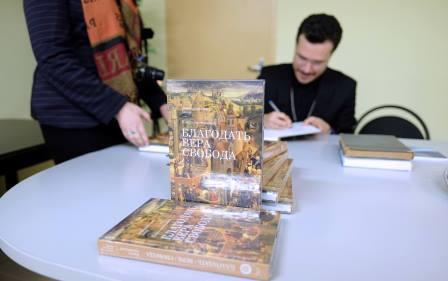
'Grace. Faith. Freedom.': Presentation of a Book of Sermons by Archbishop Dietrich Brauer

Moscow

On February 18th in the Sts Peter and Paul Cathedral in Moscow Archbishop Dietrich Brauer's 'Grace. Faith. Freedom.' book of sermons was presented.
The book is built around the church year – from Advent to to the period after Trinity including Harvest Festival and Reformation Sunday. The book includes sermons that the Archbishop gave both in Russia and in other countries. The book also has prayers for special holidays and is illustrated with paintings by Hans Memling and Rembrandt.
Martin Luther established the tradition of sermon books. Today, in the words of the Archbishop, these collections remain relevant for the Lutheran Church in Russia: “The Church exists not only in Moscow and St. Petersburg, but in very isolated regions. There are congregations with no pastor and only lay preachers or untrained leaders. Therefore it is very important to use the chance we have so that there can be materials, books, which could be used in case of need; sermon collections, therefore, can be of great assistance.”
“Grace. Faith. Freedom.” is meant not only for Lutherans: “I tried to make this collection of sermons as accessible as possible for a wide group of readers - not just for those who are our constant congregational members, but also for those who are getting acquainted with the Lutheran tradition for the first time,” the Archbishop said.
After the book presentation Dietrich Brauer answered questions from congregational members and guests at the cathedral. Answering the question about further plans for writing, the Archbishop said that he is working on his next book “Catechism.” At the end of the meeting the author signed his book, which was distributed freely to those who were in attendance.
Julia Vinogradov

Learning with Partners about the History of Islam and Orthodoxy in Kazan

On January 27 in the lilac-colored room of St. Catherine's Church in Kazan a telebridge between Kazan and partners in Germany was established for a second time. Participants included pastors from the territory of Palatinate, the former deans of Tatarstan Christian Hermann and Norbert Hussong and congregants from Kazan, led by Pastor David Gorn.
Our partners from Germany were interested in such questions as “the Lutheran Church in the Muslim Republic of Tatarstan,” “politics and government authorities,” “the religious situation (history and contemporary),” “inter-ethnic relationships in Tatarstan on all levels,” “Muslim ministers,” “the building of mosques and Orthodox cathedrals in Kazan and Tatarstan as a whole,” “mixed marriages.” We invited professionals to the discussion - the deacon of the theological department of the Russian Islamic Institute Robert Shangaraev, and the head of extension education for the Orthodox Spiritual Seminary in Kazan, priest Alexander Danilov. The telebridge began with our “calling card” - a number of hymns in German and Russian. Then there was a prayer from Palatinate, after which Pastor David Gorn from Kazan led a prayer. The "Freude" singing group led by Tatyana Fel sang "Herr, deine Güte" in German. 

Our guest Robert Shangaraev told the history of Islam in the territory of Tatarstan. Volga Bulgaria was founded in 922 with the acceptance of Islam by a number of related nomadic tribes. This helped to unite the divided tribes, improved relations with the Muslim East, introduced the Arabic alphabet and the construction of mosques began. But in the 13th century Batu Khan of the Golden Horde destroyed the settlements and incorporated the land of Bulgaria into the territory of the Horde and Volga Bulgaria ceased to exist. Part of the Bulgars migrated to the banks of the Volga and Kama rivers. In the 15th century the Golden Horde ceased to exist and as a result of the victory of Russia over them some of the land of former Bulgaria comes under the authority of Moscow, while the rest became part of the Kazan khanate. In 1552 Ivan the Terrible incorporated Kazan and the Kazan khanate into Russia. Catherine the Great allowed the building of mosques and in this way won the respect and love of the Tartar people. Karl Fuchs, a German and a professor at Kazan University, was the first to describe the life and customs and the Kazan Tatars. In the Soviet times, Muslim ministers, like all ministers in the USSR, were repressed, mosques were destroyed. Around 30 years ago the rebirth of Islam began. Old mosques were restored and new ones were built. Today in Tatarstan there are around 1600 of them; there are educational institutions – medrase - and the Bulgarian Islamic Academy has begun to work. The goal of the academy is to build and form a local Islamic theology school (Tartar academic theologians include Mardzhani Shigabutdin, Abd An-Nasir Kursavi, Gataull Bayazitov and others) and to encourage the maintenance of peace and concord in the country. 
Priest Alexander Danilov spoke about the history of Orthodoxy in Kazan. It was the same as in all the rest of Russia: 90% of the ministers were repressed or destroyed in the Soviet Times. He spoke about how today the seminary in working on new methods of communication between their students and students of other confessions. A new course is being established on the basics of Islam, and there are already intramural sporting competitions between students of the seminary and the Islamic Academy. The Christian churches host together a festival of spiritual music. 
During the meeting participants shared their own personal stories. Rafael, a teacher at the university, spoke about how he became Orthodox. He read the Gospels just out of curiosity 25 years ago, and he recognized his sinfulness and came to the church, where he saw and continues to see miracles. Eduard Gansky, a German Russian, spoke about his mixed marriage. He told about his life with his Tartar wife, with whom he has been married for 10 years. He loves her, his family and his Muslim relatives very much.They've never had any conflict on religious grounds. From the very beginning they agreed that they wouldn't talk about their religious beliefs. Eduard wished his German friends similar results in their country. A duet from the "Renaissance" chamber orchestra performed the piece written by congregational member Rudolph Brening, “At the Edge of Kazan.” The evening also was enhanced by songs from the vocal group “Kubanskoe Podvore” led by Elena Tarasova. At the end of the evening the participants of the conversation sang a hymn in two languages and prayed the Lord's Prayer.
Vera Muzafaraova

Monday, January 1, 2018

A New Church for Lutherans in Kazakhstan – the Church of Christ the Savior has been dedicated!

Astana

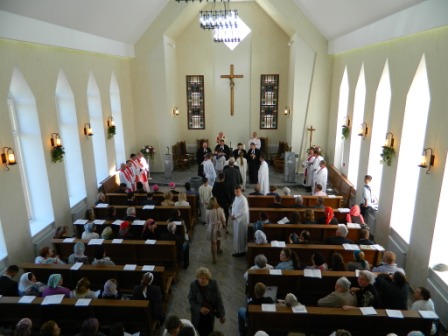
On September 17 congratulations rang out for the Lutherans of Kazakhstan who, for the first time in their century and a half history, have built and dedicated a new church building.
Among those taking part in the celebration: the Archbishop of the Evangelical Lutheran Church of Russia Dietrich Brauer, the Bishop of the German Evangelical Lutheran Church of Ukraine Sergei Mashevskii, representatives of the Circle of Friends of Kazakhstan from Mecklenburg Hans-Heinrich Yarkhov and Waldemar Henrich Zabilny, the representative of the Martin Luther Bund and the Gustav Adolf Foundation the Bishop of Halle-Wittenberg Johann Schneider, the representative of the Lutheran World Federation for Europe, Ireneus Lukas, the representative of the Evangelical Lutheran Church in Northern Germany Dean Parchima in the region of Mecklenburg Pastor Dirk Zauermann, the representative of the Evangelical Church of the Augsburg Confession in Romania Pastor Uve Zaidner, pastors, deacons, members of Lutheran congregations in Kazakhstan, sponsors of the building process.
At the ceremony of dedication representatives of the government were present – the minister of religious affairs and civil society, representatives of the akimat, the committee for religious affairs, parlament, embassies of Germany and Sweden, the Orthodox Church and the Catholic Church.
The new church complex is made up of the cathedral and the church center.  The building process began in June of 2015 and was fininshed in only 2 years and 2 months.  “It was necessary to take this step” said Albert Rau, the sponsor of the building of the cathedral as he stood by the church gate. “We thank the akimat of the city for their help in providing a property on which to build, and we thank the people of various nationalities and denominations that have given offerings both of money and also of building materials: cement, tiles, bricks. In order for our church to have a future, it needs the right conditions for working with congregational members.”
Bishop Yuri Novgorodov broke tradition a bit by inviting infants to be the first to enter the building.
“It is a blessings and a large honor for me to be here as a guest,” said Irenues Lukas in Russian as he greeted the congregation in teh name of the Lutheran World Federation's 75 million Lutherans in 145 churches in 98 countries. “You are an important part of this family. While I am here for the first time as a guest, I am not a stranger among strangers. There is no doubt that this Church on a busy street will be not only be part of the beautiful architecture of the capital, but will also contribute significantly to the life of the country. As this church is opening I see two symbolic aspects – the Church will act as a living monument to the victims of repression and also as a new place of Reformation.”
In his sermon on the Good Samaritan Bishop Novgorod quoted the words “and see—we are alive” (2 Cor 6.9); this is also the name of the exhibition in the old church in Astana. “How does the story of the Good Samaritan relate to us? Of 2000 pastors in the Lutheran Church of the Russian Empire, by 1953 there were only thre left alive. In 1955 Evgeny Bachmann led a secret worship service. 90% of those who gave offerings for the building of our cathedral were Kazakhs, Muslims- Good Samaritans.” Bishop Novgorodov thanked the Lord for this happening, for the development of the country and the foundation of its stability, for inter-religious peace and agreement.
Then the chair of the Synod Council Pastor Zhanibek Batenov voiced the decision of the council from August 24: “the name of the newly dedicated Evangelical Lutheran Cathedral in Astana will be the Christ the Savior Cathedral.”
Archbishop Dietrich Brauer reminded those gathered of their common history as he presented the book “Five Centuries of Moscow Lutherans.” “Everything that took place was not not in vain. What seemed to be the end became a beginning. Evgeny Bachmann was able to get the congregation registered with the state after all the repressions.”
Bishop of Halle-Wittenberg and representative of Martin Luther Bund and the Gustav Adolf Foundation Johann Schneider presented an altar Bible with the wish that the Word of God will remain forever.
Dean Dirk Zauermann in his speech remarked that it would be impossible to build such a big church campus in such a short time in Germany; this new building was a real breakthrough.
For 23 years Hans Yakharov has made annual trips from Mecklenburg to Kazakhstan: “I am like part of the inventory of this church. Congregational members know me; I've listened to their stories, and I am thankful for these meetings. We have been connected with your church for more than 50 years; we have seen it's growth and strengthening.” He presented the first symbolic organ pipe for the future instrument that could be a part of the church.
At the end of the ceremony of dedication a folk choir gave a concert with German and Russian folk songs. Then all of the participants and guests could continue fellowship in front of the cathedral, take pictures and try out Kazakh food and fruits.


Monday, August 1, 2016

ELCER takes part in a Conference Held by the Russian Academy of Science European Institute

Moscow, Russia
 On June 2nd in the Russian Academy of Science European Institute the 6th conference “The Religious Factor in the Social-Political Life of Russia and the Countries of the European Union” was held. 
  “The most important result for us was coming to an understanding of the religious variety of our country.” This is how Roman Lunkin, the leader of the Center for the Study of Religious and Social Issues in the Russian Academy of Science European Institute, summarized the results of the conference. “We respect all the Churches and denominations and we try to bring the Russian Orthodox Church, evangelical movements, the Evangelical Lutheran Church in European Russia and the Catholic Church together for dialog,” he added. 
  The participants of the meeting were representatives of all the traditional religions of Russia. They analyzed the role of religious organizations in social-political conflicts, in social ministry and charity work. The representative of the ELCER was Julia Vinogradov, the press coordinator of the ELCER. She spoke about the social ministry of the ELCER. 
"Specter” press bureau  

Tuesday, February 9, 2016

Dedication of a Diaconal Center in Ufa

Ufa 
On November 22 Archbishop Dietrich Brauer dedicated the building of a new diaconal center in Ufa.. The building process began in 2014, after the long-term projects of restoration of the church building and the parsonage were completed. The two-story diaconal center was built quickly, and thanks to constant financial support the total cost came to 15.3 million rubles. The largest part of that money - 14.6 million - came from a local charity fund, "Ural." The rest came from Martin Luther Bund and Gustav Adolf Werke, while the congregation also contributed 100000 rubles. 
But receiving financing is only part of a successful project. No less important is using the finances well. The building project was coordinated by Elvira Gartman, the church council president. At the Sunday worship service in the Ufa kirche, just after the dedication of the building, Archbishop Brauer gave Mrs. Gartman a medal for service to the Evangelical Lutheran Church.
The end of the building work is just the beginning. Now Ufa Lutherans will have a difficult and interesting tasks - deciding how to use this building for works of mercy and to fill it with new life. At present the congregation does not have a clear plan regarding how to do this. There are a few different ideas and they will be explored and developed as time goes on. Of course cooperation and learning from others will a big part of that work.
That was the topic of discussion at the round table hed on November 23rd in the diaconal center. Taking part were representatives of various religions and Christian denominations, NGO's and the Bashkirtostan government. The meeting was led by Pastor of the Ufa congregation, Genrich Minikh. Church workers from the local Orthodox and Roman Catholic congregations shared their experience in diaconal ministries, and they experienced their willingness to cooperate on future projects. The Bishop's Vicar of ELCER, Norbert Hintz, gave a moving example of diaconal work in the Germany context. The Muslims of the republic also expressed their good wishes. 
ELC Archbishop Dietrich Brauer, in his opening words at the round table, emphasized that "diaconal work is our answer to God's grace." May this answer given by the Ufa congregation in response to gaining a diaconal center be a worthy one! 
Office of the Archbishop


Tuesday, October 27, 2015

Inter-confessional Dialogs on Religion and Peace

Tbilisi / Moscow
  In Tbilisi in October 2014, 10 leaders of various religions (including not only Christians but also Yazidis, Jews and Muslims) were invited to visit with Georgian President Georgii Marvelashvili and his wife about violence in Georgian society, including violence against women, and what religious communities might do about it. Bishop Hans-Joachim Kiderlen represented the Lutheran church there. The reason for the president to issue this invitation was the wave of violent murders of women that have shaken up Georgian society over the past few months. These acts of violence were committed in the family, and the Georgian president asked the opinions of religious leaders about the reasons for this. The common opinion was seen as being the tension in society between traditional society, which puts men in the foreground, and the reality of the situation on the ground, where many men are not together with their families or are out of work and women take on the responsibility of supporting the family. Bishop Kiderlin noted that it was very interesting to see that none of the religious leaders disagreed with the position of the representative of the Muslim community, who said that religions do not support the traditional privileges of men and moreover, that all religions, including Islam, support equal respect and equal rights between men and women. The president also agreed and asked participants to find ways to call their congregational members to respect women and to maintain equal access to education. Bishop Kiderlin pointed out the need for congregations to do pastoral care in order to find a way of solving problems without violence.
  In Moscow on October 16th Archbishop Dietrich Brauer took part in the conference organized by the city of Moscow - “Religion and Peace.” The theme of the conference were the questions of peace and war and also the place of religion in modern large cities and the service work of denominations. Dietrich Brauer presented the work of the St. Peter and Paul's Cathedral in Moscow and spoke about the contribution of the Lutheran church to the life of the city – kindergartens, Christian theater, a place for exhibitions and organ concerns. In this way the Lutheran church is not only developing its own, individual spiritual life, but also is strengthening the ties among people, uniting them in Christian community and spreading the good news in contemporary secular society.