Showing posts with label Men's Ministry. Show all posts

Saturday, June 23, 2018

"Overhaul" - Men's Ministry Seminary for the Union of Evangelical Lutheran Churches


Omsk
“We’ve been given so much!” This was the feeling that filled those who were blessed to have taken part in the recent (May 23-27) seminar for men’s ministry in the Union of Evangelical Lutheran Church (former ELCROS). A sense of deep gratitude to God for everything that He sends us filled filled these days, and it acts as the basis for our thoughts about how we might use God’s grace for the good of our congregations and for those outside of them.
The central image of the seminar was “overhaul” which combined in a surprising way with the Biblical story of Joseph in such a way that participants could consider the unfulfilled potential in their lives. They “looked under the hood” and made a diagnosis of what needs to be changed, considering what “tools” could be helpful in the road of discipleship.
But during this seminar participants not only sat in chairs, discussing. Despite the cold-for-
spring weather, many activities were organized that helped the participants do something
 physical in order to gain new experience and to meet new challenges (for example, many tried bowling and a ropes course for the first time in this seminar), thereby gaining confidence for everyday life. 
The diversity of participants and teachers were a serious enrichment for the seminar. Christoph Baker (Germany, Apis) led sessions on the specifics of ministry with men, in particular about the relationship of men’s ministry to mission. Bradn Buerkle was the co-organizer of the seminar together with Dean of Siberia for the Evangelical Lutheran Church of the Urals, Siberia and Far East, Vladimir Vinogradov. Bradn was 
responsible for financial questions and for Bible studies, while Vladimir solved many questions related to organizational issues and led interactive exercises related to psychology and pastoral care. Participants came from Bishkek (Kyrgyzstan), Astana (Kazakhstan), Kiev (Ukraine), and from Russia (Vladivostok, Krasnoyarsk, Omsk, the Ulyanovsk deanery and the Northern Caucasus deanery). Unfortunately visa issues got in the way of the increasing the geography of the participants to include Georgia. Some of the participants are long-time leaders in the church, while some were new; just as significantly, the context in each of our churches is quite different.Yet in these days together all of these differences faded into the background as they felt unity with one another, had fun with one another, prayed with one another, thought together with one another about how the Holy Spirit is working in the churches and in each of us. It is rare to have such a chance to get together these days, but such meetings give participants energy and inspiration to try something new in their lives and in the lives of their congregations. 
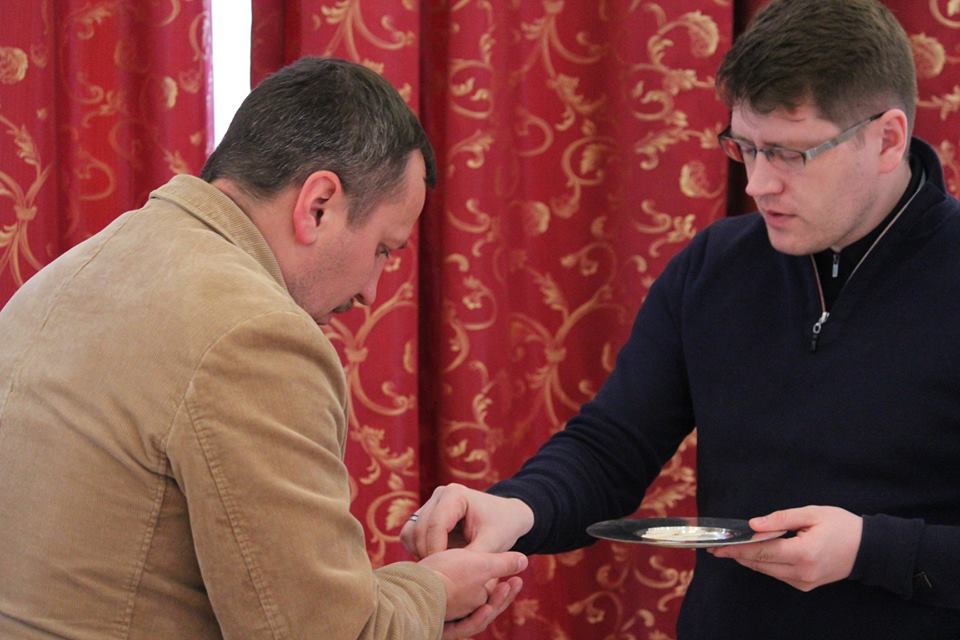
The organizers and participants of the seminar would like to thank those who made this seminar possible - in supports of the “Equipping for Service” program in the ELCA and ELM. It is the common hope that those who took part in the seminar will able to continue their “overhaul” work back at their homes in order to strengthen the spiritual lives of men and in order to invite others into Christian fellowship.

Monday, January 1, 2018

Men's Ministry

Omsk
Getting men involved in our communities of faith has proven to be a challenge. It was a blessing, then, when early this fall fourteen men left their homes in cities as far west as Crimea and as far east as Krasnoyarsk in order to meet in Omsk for a seminar for leaders of men's ministry.

The theme of the seminar - “Brotherhood” - was highlighted by former ELCUSFE Bishop, Volker Sailer, during Bible studies. Area Dean for Siberia Vladimir Vinogradov put together an interesting program with practical and team-building exercises that not only were effective for the group, they also served as an example for what could be done in other locations. Together the men were able to open up about their experiences as disciples of Christ, as sons, husbands and fathers, and to support one another. As one of the participants put it, when they left they had a renewed sense that taking responsibility for the church's life is “not something that should be hoisted onto the shoulders of our mothers, grandmothers, and sisters;” it is important that men carry their share.

Restoring a sense of balance and of mutual responsibility will do much to improve the health of our congregations. We still have some way to go. Two of our aims with this seminar – that we would bring together those already highly experienced in the field and that we could bring in participants from other countries – went unrealized. We've decided to do one more push in this direction 2018 – we hope that in May more participants from the former USSR will be able to attend and that we can come together to work on a concrete program of activities that the leaders will then be able to replicate in their home regions.


Thursday, December 14, 2017

Men's Seminar

My years in Russia have taught me that some of my pre-conceived notions about mission and ministry are misguided...or, at least, that they are not completely applicable to this context. One of those examples is "men's ministry." In the past I had a notion that this was a way for men to assert their authority in the church and in their families. This looked a lot like encouraging patriarchy, certainly not something in which I would want the church to be engaged. 
Here, however, in addition to there being a different set of issues around gender and roles than in the West, there is is the problem of an almost total absence of men in many congregations. "Men's ministry," as I see it being developed here in the Omsk region of Evangelical Lutheran Church in the Urals, Siberia and Far East, is not about re-asserting men's power, but is instead an attempt to help men see that there is a place for them in the church and to give them the opportunity to be surprised both by their potential usefulness and by the support which they didn't even acknowledge that they needed. 
For that reason I've been hoping to find a way through the "Equipping for Service" program to support an idea I heard at the last synod assembly of the Evangelical Lutheran Church in European Russia. There my successor as pastor of St. Nikolai Lutheran in Novgorod, Igor Zhuravlev, mentioned the lack of men's ministry (despite a thriving women's ministry) at the last ELCER synod. I suggested to him and then to the folks in ELCUSFE that he and I travel to Omsk, where they've been doing such work for a few years. He agreed, and our hope was to go a see a model that we might use to replicate (with certain modifications) in European Russia. 
We arrived on Friday morning and left Omsk for the  “Admiral Makarov” camp in the early evening. One of the most impressive things about the seminar was the way different types of activities were planned and balanced. We started with bowling and a meal Friday, while on Saturday we had activities that were more about listening (morning prayer, Bible study) or about talking (stereotypes about men, a survey of questions about our live's most significant moments), were more focus was on the physical (winter soccer and capture the flag) or the mental (chess with living figures). 
Sunday morning was used for morning worship, another activity reflecting on mens' roles, and final reflections before leaving back for Omsk around noon.
By the end of the weekend the seminar's 13 participants had had the opportunity to reflect, be encouraged, experience renewal, and come away with a new sense of brotherhood. 
While it would be wrong to underestimate the importance of the unique character of the gathered group (Omsk has a good team of leaders that know one another well) we came away from the seminar with the realization that, because this is a need that is not currently being met, it really is important to try to hold a similar activity in other places. Dean Vinogradov also saw the potential to build on what has already been accomplished, and he and I are making plans for a church-wide (including participants from other parts of the former Soviet Union) coordinators' seminar in September.

Bradn Buerkle

Monday, November 16, 2015

Walls to Protect or to Divide?

Omsk
  “Let us go build a wall!” - this was the theme of the latest seminar for Christian men held on February 20-22 at the Admiral Makarov camp in the Omsk region. These seminars take as their theme one particular person from the Bible, and this time it was the prophet Nehemiah. Around 2400 years ago Nehemiah, who occupied a high-level government office in the court of the Persian king, asked to become the governor of the province of Judea and was granted permission to restore the city of Jerusalem. “”Let's go build a wall!,” he told his fellow countrymen. And they responded. Despite enormous difficulties – a huge need for resources, enemy attacks, treacherous friends and the burning sun – Jerusalem was restored.
  The wall that defended the holy city from its enemies was built in a record time – in 52 days! Nehemiah's work was a great success. How did that happen? The book of Nehemiah tells us...and it gives us guidance as to how we can attain our goals in life – that was what the seminar was about. A wall is that which, first and foremost, defends us, our families, our faith. A strong wall cannot be built alone, but only together...yet even unity among people is not enough: “Unless the LORD builds the house,  its builders labor in vain.” Nehemiah inspires us to trust the Lord God in all our endeavors.
  Walls also function in another way - they divide, not only cities and countries, not only people of various nations and faiths, but also people who had once been close to one another – spouses, parents, children... We build these walls ourselves and it is not easy to break them down. During the seminar participants also learned how the Word of God helps us to tear down the walls that divide us. The Scripture lessons were reinforced by time spent in fellowship, for example, through sports – the participants learned how to play rugby this time!

  There were many surprises throughout the seminar, but some things remained the same – wonderful weather, fresh air, friendly fellowship, well-organized events and the Lord's blessing. The latter will help all who participated build walls that protect and tear down walls that divide.