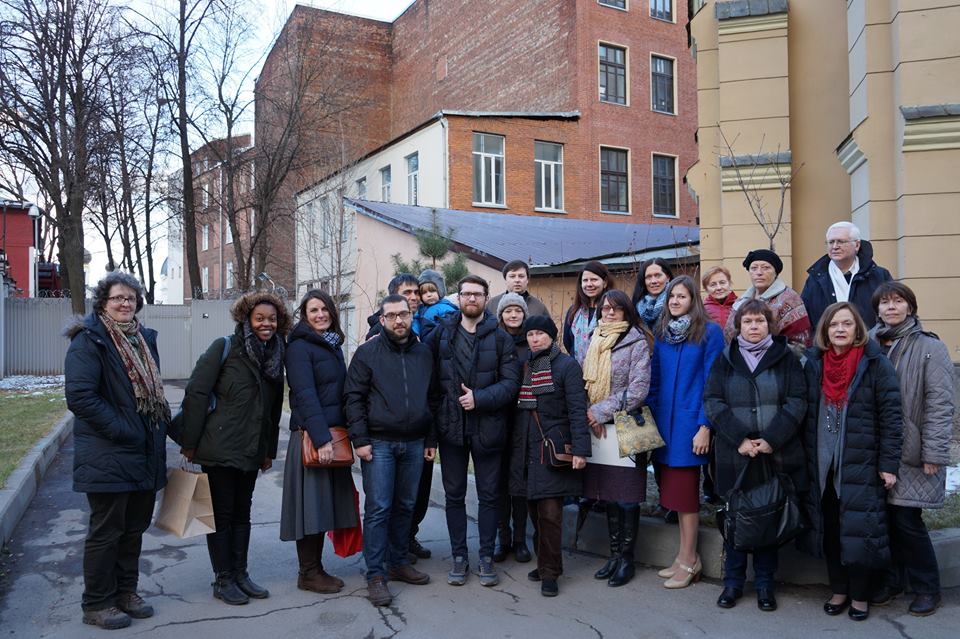
Showing posts with label Equipping for Service. Show all posts

Saturday, June 23, 2018

"Overhaul" - Men's Ministry Seminary for the Union of Evangelical Lutheran Churches


Omsk
“We’ve been given so much!” This was the feeling that filled those who were blessed to have taken part in the recent (May 23-27) seminar for men’s ministry in the Union of Evangelical Lutheran Church (former ELCROS). A sense of deep gratitude to God for everything that He sends us filled filled these days, and it acts as the basis for our thoughts about how we might use God’s grace for the good of our congregations and for those outside of them.
The central image of the seminar was “overhaul” which combined in a surprising way with the Biblical story of Joseph in such a way that participants could consider the unfulfilled potential in their lives. They “looked under the hood” and made a diagnosis of what needs to be changed, considering what “tools” could be helpful in the road of discipleship.
But during this seminar participants not only sat in chairs, discussing. Despite the cold-for-
spring weather, many activities were organized that helped the participants do something
 physical in order to gain new experience and to meet new challenges (for example, many tried bowling and a ropes course for the first time in this seminar), thereby gaining confidence for everyday life. 
The diversity of participants and teachers were a serious enrichment for the seminar. Christoph Baker (Germany, Apis) led sessions on the specifics of ministry with men, in particular about the relationship of men’s ministry to mission. Bradn Buerkle was the co-organizer of the seminar together with Dean of Siberia for the Evangelical Lutheran Church of the Urals, Siberia and Far East, Vladimir Vinogradov. Bradn was 
responsible for financial questions and for Bible studies, while Vladimir solved many questions related to organizational issues and led interactive exercises related to psychology and pastoral care. Participants came from Bishkek (Kyrgyzstan), Astana (Kazakhstan), Kiev (Ukraine), and from Russia (Vladivostok, Krasnoyarsk, Omsk, the Ulyanovsk deanery and the Northern Caucasus deanery). Unfortunately visa issues got in the way of the increasing the geography of the participants to include Georgia. Some of the participants are long-time leaders in the church, while some were new; just as significantly, the context in each of our churches is quite different.Yet in these days together all of these differences faded into the background as they felt unity with one another, had fun with one another, prayed with one another, thought together with one another about how the Holy Spirit is working in the churches and in each of us. It is rare to have such a chance to get together these days, but such meetings give participants energy and inspiration to try something new in their lives and in the lives of their congregations. 
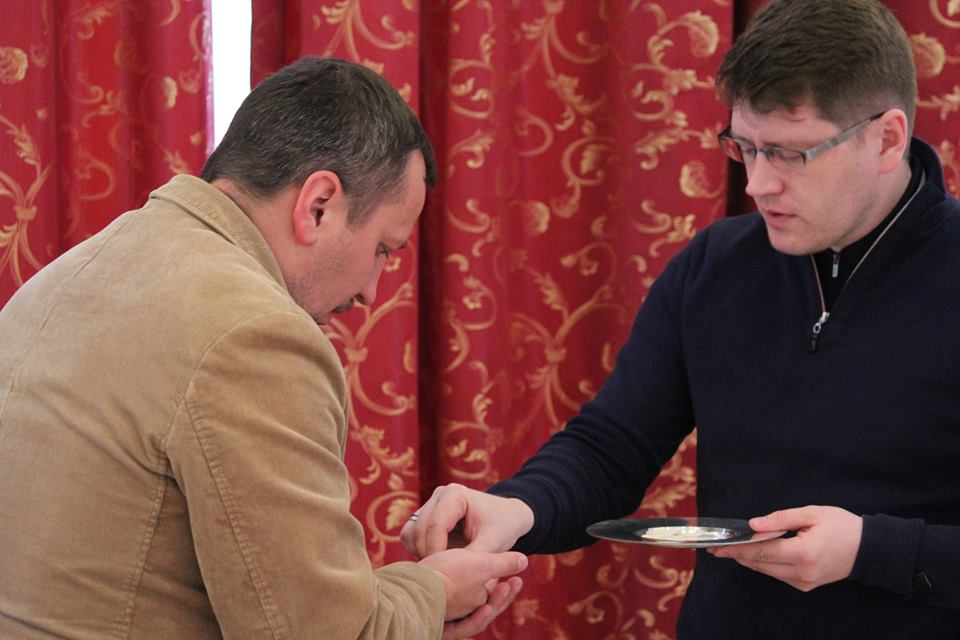
The organizers and participants of the seminar would like to thank those who made this seminar possible - in supports of the “Equipping for Service” program in the ELCA and ELM. It is the common hope that those who took part in the seminar will able to continue their “overhaul” work back at their homes in order to strengthen the spiritual lives of men and in order to invite others into Christian fellowship.

Saturday, April 7, 2018

Christ in the Center

Ufa
 A good tradition of hosting theological seminars has been established in the Lutheran church in Ufa. At the end of last year there was such a seminar with participants from Bashirk State Pedagogical University, and recently a week-long seminar on the theme “Christ in the center” was held in the diaconal center of the Ufa kirche. It ran from February 20 to 24 with participants from congregations in Ufa, Sterlitamak, Orenburg, Sol-Iletsk, and the village of Prishib. Seminary President Anton Tikhomirov spoke about justification, the theology of the Word in Lutheran theology, and the theology of the Cross. Igor Zhuravlev spoke about prayer and an overview of the Gospels of Mark and John. Bradn Buerkle spoke about the synoptic Gospels, diaconal service and Christian ethics. There was a lot of dialog and discussion in these themes, including exercises and watching the films “Winter Light” and “Silence” together.
It seems that during such events the idea of the Reformation that Martin Luther led 500 years ago are brought to life - Christianity as a system of faith becomes no longer the prerogative of the clergy but belongs truly to the people. Through studying together the Word of God becomes clear and understandable to ordinary people and they begin to build all aspects of their life around it.
Sergei Rusakov


Meeting of Staff from the Omsk Region


Omsk
The annual meeting of staff of the Omsk region took place in the Christ Church Center in Omsk on February 10. Pastors, lay preachers, staff and specialized ministers came together to report on the past year, plan for the year ahead, and have fellowship with one another and with guests from Germany and the USA.
Those in attendance heard about various events in the areas of family ministry and women's ministry, and about the men's seminars that take place twice a year. The people responsible for youth and family ministries in the deanery gave presentations on the summer camp, children's evangelization ministry and the “Together with Mom” project that includes ministry with special-needs children.

Bishop Alexander Scheiermann of the Evangelical Lutheran Church of the Urals, Siberia and Far East greeted those in attendance and passed on greetings from the other regions and congregations of the church; he spoke about his ministry and about the state of affairs in the Church. The main subject of the meeting was a lesson entitled “Inviting Congregations” led by retired ELCUSFE Bishop, Volker Sailer. He spoke about what a hospitable congregation looks like, about church workers and the qualities that they have that can draw people to church (or turn them off to it), about the different types of congregations and about how small and large congregations need different methods for ministry.
Viking Dietrich, regional representative of the Evangelical Lutheran Church in America Global Mission was a guest at the meeting; he was accompanied by Pastor Bradn Buerkle, who talked about the “Equipping for Service” educational project that he leads and the distance education program of the Novosaratovka Theological Seminary.

Thursday, December 14, 2017

Cooperation with PCUSA

The Presbyterian Church (USA) has worked in Russia since shortly after the fall of the Soviet Union; their unique role throughout the years has been to cooperate with the ministry of the country's historic Christian denominations (which, speaking generally, does not include Presbyterians, but does include Orthodox, Baptists and Lutherans). Their efforts to show support across denominational lines has been an impressive witness of commitment to true Christian unity.
While PCUSA has been engaged mostly with Baptist and Orthodox churches, but they've supported the Lutheran church in significant ways, too. In particular, for many years they supported the teaching ministry of Dr. Joseph Kang at the Theological Seminary in Novosaratovka, and through their area representative, Ellen Smith, they've also occasionally worked out partner congregations between the U.S. and Russia.
It was with working toward this goal that Ellen Smith joined fellow American, Pastor Bradn Buerkle (who leads the off-site, “Equipping for Service” educational program for our church), on a trip to the Northern Caucasus deanery near the end of March. Area Dean Sergey Maramzin received the guests, whom he invited to visit congregations in the region and to take part in a deanery seminar about the anniversary of the Reformation. Pastor Buerkle prepared lesssons, while Dean Maramzin prepared the place; he has been working very hard to construct (much with his own hands) a small retreat center that could be used for deanery-wide events or simply for individuals looking for a place of spiritual restoration.
The building was filled with capacity, then, when twelve people from four different locations came for the day-long seminar; there they got a short refresher course in the basics of Lutheranism, met Ellen and heard about her church, and also checked out the new retreat center. A good impression was formed on all sides – clearly the retreat center is useful and comfortable, the lessons were helpful review and also provided new perspectives on a few questions, while the hope of developing a relationship between the region and a U.S. congregation seems realistic. After a long period of stagnation, it is clear that the Lord's Spirit is moving among the believers in the Northern Caucasus, and God has blessed the region with a commitment by the church to support its further development.

Ellen continued to contribute to our church life later in the month by helping to arrange a seminar in Moscow for those engage in diaconal ministry. Artis Petersons made the arrangments on the ELCER side, and the “Equipping for Service” program covered expenses.
Two teachers from PCUSA - women engaged in diaconal ministry in very different ways (one through the organization of lay ministers groups, the other as a sociologist) – shared their knowledge with the ecumenical, international, and intergenerational group that gathered for 3 full days of classes.
Both the teachers and the participants of the course came away feeling enriched, and in this way the seminar reflects all the ways we have interacted with PCUSA throughout the years. 

Tea with Milk, Paul with Luther, Bashkortostan with Sisters and Brothers

Ufa
It is hard for me to say which part of my ministry I enjoy more - returning to congregations where I have already been (which gives me the chance to see how God has been working there since my last visit) or coming to a place for the first time. The latter not only gives me the chance to meet new brothers and sisters in faith but, almost without exception, teaches me something new about the country where I am serving. This is particularlly true, I've found, when visiting regions of the country with significant regional ethnic and/or religious differences. This was the case when I visited Ufa, the capital of Bashkortostan, a majority-Muslim region in the eastern part of European Russia.
In just a few days there one could feel some differences - in the way people looked, in the architecture and pace of life, in the tea they drank (everyone had it with milk)... in short, Ufa showed me that this huge country can continue to surprise me.

The Lutheran congregation in Ufa, however, fit in to a pattern I have seen in many places around the country - a strong lay woman, inspired by her faith and driven by a God-given strong will, accomplishes the miraculous.  In this case her name is Elvira; she (not single handedly, of course, but certainly as the leader of the charge) was able to get the local government to return the congregation's historical building. 

Not only that, she is able to find sponsors - in this case many of them local - to restore the "kirche," and today it is a small but beautiful church snuggled in Ufa's historical center. But the story doesn't stop there. Elvira was able to find a way to dismantle the warehouses that had been built in Soviet times on former church property and have built in their place a new congregational center. As sometimes is the case here, while all of these practical concerns have been on the front burner, congregational life as such has been given less of a priority. A clear witness to this fact - Sunday worship in which large parts of the liturgy are translated from German into Russian; hardly a satisfactory worship experience for anyone new, and certainly unnecessary when there there are no exclusively German speaking people in the congregation. 
I learned all of this during the past month, after long discussions with congregational leaders finally lead to my first seminar in the region. The idea began to take shape in conversation with an extension student from Ufa at the Theological Seminary and started to take on concrete form after speaking with the congregation's at the pastors' gathering in Crimea in September 2016. We agreed then that the February Men's Day holiday weekend would be the best time, and we were not mistaken - free days without many obligations led to us being able to attract a good-sized group of participants.
Pastor Igor Zhuravlev joined me for this seminar to help me teach on " Paul and Luther," insofar as I have wanted for quite some time to give him the opportunity to teach and to put to use the Master's degree in theology that he earned at the Christian university in St. Petersburg. Originally I had thought that it would be the two of us teaching, but in the end Anton Tikhomirov joined us to take part in two days of teaching. While these changes led to greater cost for transport, this seminar's overall expenses were kept low thanks to local contributions (which covered room, board, and local transport).
Our time in Ufa was broken up into a number of segments – teaching for members from the Bashkortastan and Orenburg deaneries, a public theological conference on the 500th anniversary of the Reformation, a youth group meeting (the first time I've led youth group for many years; I chose the theme “Be yourself, be free”) and worship.
The seminar was well attended, with 18-23 participants engaged at various moments. The conference (with speakers arranged by the local congregation in particular through ecumenical and scholarly contacts) had seven speakers and around 30 participants. 

The wonderful facilities and hospitality in Ufa created a very positive environment for such seminars. There seemed to be a hunger there to expand and deepen congregational life and, while the topic was challenging for those who are not used to dealing with theology, I found that the participants were good, engaged listeners. I pray that as they look forward to their next steps I can help play a positive role in their journey of discipleship. 
Bradn Buerkle

Men's Seminar

My years in Russia have taught me that some of my pre-conceived notions about mission and ministry are misguided...or, at least, that they are not completely applicable to this context. One of those examples is "men's ministry." In the past I had a notion that this was a way for men to assert their authority in the church and in their families. This looked a lot like encouraging patriarchy, certainly not something in which I would want the church to be engaged. 
Here, however, in addition to there being a different set of issues around gender and roles than in the West, there is is the problem of an almost total absence of men in many congregations. "Men's ministry," as I see it being developed here in the Omsk region of Evangelical Lutheran Church in the Urals, Siberia and Far East, is not about re-asserting men's power, but is instead an attempt to help men see that there is a place for them in the church and to give them the opportunity to be surprised both by their potential usefulness and by the support which they didn't even acknowledge that they needed. 
For that reason I've been hoping to find a way through the "Equipping for Service" program to support an idea I heard at the last synod assembly of the Evangelical Lutheran Church in European Russia. There my successor as pastor of St. Nikolai Lutheran in Novgorod, Igor Zhuravlev, mentioned the lack of men's ministry (despite a thriving women's ministry) at the last ELCER synod. I suggested to him and then to the folks in ELCUSFE that he and I travel to Omsk, where they've been doing such work for a few years. He agreed, and our hope was to go a see a model that we might use to replicate (with certain modifications) in European Russia. 
We arrived on Friday morning and left Omsk for the  “Admiral Makarov” camp in the early evening. One of the most impressive things about the seminar was the way different types of activities were planned and balanced. We started with bowling and a meal Friday, while on Saturday we had activities that were more about listening (morning prayer, Bible study) or about talking (stereotypes about men, a survey of questions about our live's most significant moments), were more focus was on the physical (winter soccer and capture the flag) or the mental (chess with living figures). 
Sunday morning was used for morning worship, another activity reflecting on mens' roles, and final reflections before leaving back for Omsk around noon.
By the end of the weekend the seminar's 13 participants had had the opportunity to reflect, be encouraged, experience renewal, and come away with a new sense of brotherhood. 
While it would be wrong to underestimate the importance of the unique character of the gathered group (Omsk has a good team of leaders that know one another well) we came away from the seminar with the realization that, because this is a need that is not currently being met, it really is important to try to hold a similar activity in other places. Dean Vinogradov also saw the potential to build on what has already been accomplished, and he and I are making plans for a church-wide (including participants from other parts of the former Soviet Union) coordinators' seminar in September.

Bradn Buerkle

A Retreat in the Russian Forest

While it certainly wasn't the taiga, the vast forests of more isolated portions of Siberia, the tur baza (more or less like a camp) called “Russian Forest” still made for a good spot for folks from the Omsk region to get away from the city and its cares and to come together to think and pray about how God is calling them to develop.
Last year Pastor Len Dale (from the ELCA Central States Synod) and I made a trip to a number of sites in order to lead short seminars on strategic congregational development. Dean Vladimir Vinogradov liked that seminar enough that he asked that I come back to his region this year for follow-up.
In mid-March, then, 12 congregational leaders from 5 congregations (Beryovovka, Zvonarev Kut, Kazanka, Azovo and Omsk) in addition to myself and Dean Vinogradov got together for a weekend retreat. Dean Vinogradov led morning and evening prayer based on the Biblical theme of the weekend – Mt. 9.38 – while I led the lessons related to analysis of the congregation's situation, it's gifts and it's potential call as the people of God in that place. In addition to study and application of the book of Acts, we also covered materials that are applicable to almost any organization regarding life-cycles, focus and goal-setting. The mix of the practical and theoretical, of the human and divine elements of the church, brought a lot of life to our discussions, work and plans.

Because we saw the need for continued work in this area Dean Vinogradov and I agreed that it will be important to find good ways to follow up with those who attended. One option would be to plan a similar seminar (though introducing different tools and with the attempt to go deeper) for next year. A second option would be to try to gathered representatives of larger congregations together insofar as they face a common set of challenges and have significantly more opportunities than congregations with fewer human resources. Another option would be consultation, where someone would come in to help congregations analyze their ministries and mission opportunities. We will see where God leads us, as through the “Equipping for Service” program we strive to continue to increase the capacity of the Russian church to spread Christ's love.

Bradn Buerkle

Thursday, October 20, 2016

ELCER Pastors' Conference

Evpatoria, Crimea
A conference for pastors of the Evangelical Lutheran Church of European Russia was held on September 27 to the 30th. It was dedicated to questions of family values and the Biblical image of the family as well as the image of the Church and congregation as family in Scripture. Pastors and preachers in the Church came with their families to a beautiful corner of the Crimean peninsula for work, rest and fellowship.


The following people gave papers at the conference: the Archbishop of the Evangelical Lutheran Church in Russia Dietrich Brauer, Pastor Stephanie Fendler of the Evangelical Church in Germnay, Elizabeth Hintz (who is responsible for women's ministry in the city of Wilstedt, Germany), Pastor Bradn Buerkle head of the “Equipping for Service project, Pastor Norbert Hintz, the vice-Bishop, and Dean of the Central Deanery Elena Bondarenko. 

The vice chair of the Committee for State Committee for Inter-ethnic Relations, Yuri Gempel, attended the event. He greeted participants of the conference and expressed his willingness to support Lutheran congregations in Crimea. 
As part of the pastors' conference there also was a special meeting of the ELCER synod assembly. At this meeting delegates for the church-wide assembly were elected and Ekaterina Kreimer (Samara) was named the coordinator of Children's Ministry in the ELCER, while lay minister Artis Petersons (Moscow) was named the coordinator for diaconal ministry in the ELCER. These two coordinators were installed at the final worship service by Archbishop Brauer. 
At the end of the conference representatives of the church administration visited the congregation in Evpatoria and the “Ludwigsburg” German Cultural Center. The ELCER supports the congregations of Crimea which, at the same time, remain in contact with the German Evangelical Lutheran Church in Ukraine. Lutherans move across political borders and pray together for peace.
From the ELCER site,   http://www.peter-paul.ru/

Sunday, August 7, 2016

"Healthy Congregations" in the Ural Deanery

Chelyanbinsk, Russia
  Every year (and sometimes twice a year) leaders from the Ural deanery of the Evangelical Lutheran Church in the Urals, Siberia and Far East get together for fellowship and continuing education. This April over 30 pastors, lay ministers, and church council members from more than half a dozen congregations gathered for a two days at a camp/retreat center outside of Ekaterinburg.
  I was happy to receive the invitation from Dean Waldemar Jesse to be the teacher for the weekend; we agreed together that the theme for the weekend would be "healthy congregations." My main goal for our time together was to motivate congregational leaders to analyze their congregation's life and to consciously listen to the Spirit's calling for the development of their particular congregations. Participants were very engaged, and I had a great time both leading lessons and participating in other parts of the weekend, including morning runs and evening bowling.


  By Saturday evening we had made the trip through beautiful pine forests and lake-filled landscapes to Chelyanbinsk, where I had the chance to see one of the few new church buildings in our church and to preach there the next morning. 
  It is my hope that such experiences continue to build up trust and cooperation between the Ural deanery and other parts of our church, despite some differences in piety and theological accents.   

Monday, March 7, 2016

Four Evangelists of the End Times

Novosaratovka

From January 19-29 at the Theological Seminary in Novosaratovka a seminar was held on the theme “Death, Burial and Eschatology.” Participants came from Novgorod, Moscow, Ufa and Narva (Estonia). 
Questions of the end of life and the end of time are of concern for any person, regardless of his or her religion or nationality. In addition the question of death is one of the primary issues in pastoral care. The teachers of the seminar – Anton Tikhmirov, Bradn Buerkle, Michael Schwartzkopf and Datze Balode – helped us deal with these difficult questions. And as the four Evangelists each spoke about Christ in their own way, our four teachers each pointed to eschatological issues in a different way. We looked both at traditional Christian teachings on eschatology as well as contemporary approaches to the “end times.” Many of these ideas provoked discussion which continued after lectures into the student kitchen in the evenings. 
The students thank the teachers, the staff of the seminary for arranging everything so well, the local pastors of Lutheran congregations for their hospitality during worship and also the staff of the Christian book store “Slovo” for helping us find the literature we need. 
Rustem Nafikov
Photos: Ruth Stubenitzky


Wednesday, February 10, 2016

Seminar for Congregational Leaders in Omsk

Participants of the seminar in Omsk for ELCUSFE congregational leaders share their impressions:


It was the first time I attended this annual seminar for leaders and staff of ELCUSFE congregations. The seminar was very intense and enlightening. We studied God's Word, prayed and had fellowship with one another. 
Many thanks to Bradn Buerkle for his clear explanations about how to prepare a sermon; I got a lot from that. I hope that it won't be in vain. 
I was happy to meet many people whom I'd know before as well as those acquaintances whom I was meeting agin. Some of the participants were from Vladivostok or Magadan - I'm thankful to them that they came to the seminar from so far away. There were also brothers and sisters from Novosibirsk, Omsk, Chelyanbinsk, Brezovskiy, Kuragino, Nizhny Tagil, Chernogorsk, Krasnoturinsk, Ekaterinburg and Tjumen. 
May God continue to bless such seminars. 
Natalya Kadakh. Chelyabinsk.


The teachers of the seminar have great gifts and with God's help they use them to help us do that to which we are called - to glorify our Lord Jesus Christ. Many thanks to them for that! We received a lot to think about in these days, and it will take time to understand how we can use what we learned in our congregations. The material we covered was of very high quality and was, without a doubt, very useful.
Evgeny Strikker, Ekaterinburg.


There is no such thing as an ideal congregation and there is no such thing as an ideal sermon. But we can say "Here am I!" to the call to serve and trust God for support.
Nina Dmitrieva. Vladivostok. 

I liked very much that in Bradn's lessons we balanced theory and practice so that we eventually made a sermon outline and them a sermon itself. It was possible to answer questions right away and look for an answer together. I could have used more time to move around, since it is hard to sit so long for a few days in a row! Many thanks to Otto Schaude for interesting lessons. I wish God's blessings to all the teachers and staff.
Irina Schneider. Khakasia. 


There was a funny thing that happened at the seminar. In our large church, made up of 4 deaneries, one song can be sang in four different ways. We tried to sing together "Abide With Me," but participants of the seminar started to sing 3 different melodies. In the end we sang "in the Azovo" way (Azovo - a town in the Omsk region) but it was very interesting to hear new versions of well-known hymns. 
Maxim Shekker. Tjumen.


It was very interesting to me to receive new experience and knowledge about how to prepare sermons. I learned about the principles of preaching, what should be avoided and what is recommended. In groups we worked on sermon planning, and I'll use that in worship services in the near future. Besides that the seminar was a very valuable time of fellowship with brothers and sisters in Christ from other regions - "they were together in the temple, praising and blessings God." (Lk 24.53)  
Sergei Zaibert, Omsk.


Saturday, February 6, 2016

Conflict and Humillity - Seminar in the Abakan Region

Abakan
In the family and at work, with friends and among strangers, almost in every situation in life we run into conflicts. They also are part of are lives as believers, and they disturb peace and harmony in our families and in our congregations. Some Christians look at conflicts pragmatically, others are disappointed, others still close their eyes to the facts because they have the illusion that conflicts and Christian humility are incompatible.
Thinking about this, understanding the nature of conflicts and finding a Christian approach to them was the goal of the seminar held in the Abakan region of the Evangelical Lutheran Church of the Urals, Siberia and Far East from September 24 to 27. Various themes were approached, such as examples of conflict in the Bible, psychology and conflict studies, the theological concept of humility. During lively discussions we looked at real life situations that are part of life in and outside the congregation.
The main teacher for this seminar was the leader of the “Equipping for Service” project, Pastor Bradn Buerkle from St. Petersburg. The congregations in Khakasia and the south of the Krasnoyarsk krai know him well and respect him.
In order to include the most people possible it was decided that the seminar would be held in Abakan. Besides the locals, then, members from congregations in neighboring Chernogorsk and also congregations further away – Bograd and Kuragino – were able to attend.
The participants of the seminar are thankful to God for the possibility to have this wonderful meeting and hope that the knowledge and ideas gained at the seminar will provide spiritual enrichment and further development of congregations in the Abakan region.
Pastor Dmitry Schweitz


Thursday, February 4, 2016

22nd Summer Seminar in the Far East Deanery - The Church as a Special Community in the World

Adapted from materials on the site of the Deanery of the Far East: luthvostok.com

This was a very special seminar. There were participants from each of our 9 congregations. There were 36 persons in attendance including 4 lecturers (Pastor Bradn Buerkle from St. Petersburg, Pastor Alexander Lapotschenko from Arsenyev, Preacher Nina Dimitrijewa and Pastor Manfred Brockmann from Vladivostok) and 8 guests who paid their own way. We were at the same beautiful place where we have held our Deanery seminars for many years. 
The main theme for this seminar was The Church. The seminar had four large units.
1) Bradn Buerkle showed us by walking us through the Bible in an impressive way that the people of God have always been a special community in this world.
2) Pastor Lapotschenko  showed us in a very interesting way how the church developed over the centuries. He named his unit “The Tree of the Church” and that was a very fitting title. He said there is one root, Jesus Christ, from this root a tree has grown with many different branches.
3) But there are so many problems and conflicts in the church. This was the topic for Pastor Bradn Buerkle’s unit entitled, “Conflicts--How To Live with Them and Overcome Them” This topic was understandably of interest to our participants, because who doesn’t have lots of problems in their lives!
4) Another relevant unit came from Dean Brockmann, who told about his trip that just happened in June. This was a trip to visit our American partner churches in the Central States Synod. He also talked about the brotherhood and unity of the Christian Church that transcends cultural and international borders. These many partnerships with churches of our deanery with churches in America must be revitalized anew. Dean Brockmann put the words of the new Bishop of the Central States Synod on the blackboard: “Our society is so loud, that it is becoming harder and harder to hear the quiet voice of God. ” It was necessary to announce this statement because some people were making such a racket with their radios and laptops and this was happening at a place of solitude, without any television or radio.
There was further focus during the seminar on the following:
--The unity of “Paul and Christ. Who is close to Jesus Christ?” Dean Brockmann worked with us on this topic. Paul never saw the historical Jesus but in spite of that he became his greatest Apostle. He saw the risen Christ. And that is still possible today. This was made clear to us based on the essay by Alexander Menh, “Encounters with the Risen Christ.” After all, whoever is baptized, lives in Christ (Romans 6:3; Galatians 3:27) and Christ lives in them, (Galatians 2:20). The greatest task and passion for the Christian in this life is to know Christ more and more.
--This was followed by a unit taught by our Nina Dmitrijewa. She spoke to us about the theme for the World Day of Prayer for 2016. She conducted a Bible study using Mark 9:37 and about the themes of “Faith, Love and Hope.”
---Music had a special meaning for us. We had some very talented people and among them was Tatyana Filobok from St. John’s Church in Chabaroffsk. She led our group singing and the group was accompanied by Nadjeschda on the violin and Manfred Brockmann on the viola. Everyone really got involved and Bradn Buerkle commented afterwards: “That was the highlight of our seminar.” 
There was of course a large Council Meeting of the Deanery, in which all of the congregations had their say.
Our biggest problems are -the St. Mark’s congregation in Magadan, which still hasn’t been able to find renters for the rooms in their congregational building and --the St. Matthew’s Church in Tschita, which is in desperate need of a pastor and also needs a congregational building. There are some unbelievable people serving this congregation! --Some very happy news was reported from St. Luke’s in Arsenyev. Their faithful partner congregation, Trinity Lutheran in Great Bend gave them some very generous help. St. Luke’s is not going to hire a firm for the addition to their church building. Instead they are going to do all the work themselves. The entire congregation is joining together to do this. That is because the right people got the money!
We then had an evaluation of the seminar. There were a variety of responses. - Oleg said, “I recovered quite well. (Why wouldn’t you).-- Ludmilla P. said “Especially good units by Bradn Buerkle, Nina Dmitrijewa and Manfred Brockmann , and she also said “The next time we will need to choose our participants more carefully.” ( Yes!). Tatyana Filobok said, ”Thank you to everyone, but special thanks to Manfred Brockmann for organizing these seminars. (This recognition was well received by him.), but also to quiet, faithful Edik, even though he couldn’t prevent three bus mishaps. We are all such different people.” --Olga Linker said (photo) “Everything was so good. We would like to see something like this again, with the children present.”-- Ekatarina Weitz.said, “Thanks. Everything was so nice especially the sea. We were so happy.” --Nina Dmitrieva said, “Thank you all so much that you all listened to me when I spoke. I would like to communicate, what I know” -- Svetlana Mik said, “I haven’t been here for two years. It is so good for me to get together with my brothers and sisters from far away.”