Showing posts with label Astana. Show all posts

Monday, January 1, 2018

A New Church for Lutherans in Kazakhstan – the Church of Christ the Savior has been dedicated!

Astana

On September 17 congratulations rang out for the Lutherans of Kazakhstan who, for the first time in their century and a half history, have built and dedicated a new church building.
Among those taking part in the celebration: the Archbishop of the Evangelical Lutheran Church of Russia Dietrich Brauer, the Bishop of the German Evangelical Lutheran Church of Ukraine Sergei Mashevskii, representatives of the Circle of Friends of Kazakhstan from Mecklenburg Hans-Heinrich Yarkhov and Waldemar Henrich Zabilny, the representative of the Martin Luther Bund and the Gustav Adolf Foundation the Bishop of Halle-Wittenberg Johann Schneider, the representative of the Lutheran World Federation for Europe, Ireneus Lukas, the representative of the Evangelical Lutheran Church in Northern Germany Dean Parchima in the region of Mecklenburg Pastor Dirk Zauermann, the representative of the Evangelical Church of the Augsburg Confession in Romania Pastor Uve Zaidner, pastors, deacons, members of Lutheran congregations in Kazakhstan, sponsors of the building process.
At the ceremony of dedication representatives of the government were present – the minister of religious affairs and civil society, representatives of the akimat, the committee for religious affairs, parlament, embassies of Germany and Sweden, the Orthodox Church and the Catholic Church.
The new church complex is made up of the cathedral and the church center.  The building process began in June of 2015 and was fininshed in only 2 years and 2 months.  “It was necessary to take this step” said Albert Rau, the sponsor of the building of the cathedral as he stood by the church gate. “We thank the akimat of the city for their help in providing a property on which to build, and we thank the people of various nationalities and denominations that have given offerings both of money and also of building materials: cement, tiles, bricks. In order for our church to have a future, it needs the right conditions for working with congregational members.”
Bishop Yuri Novgorodov broke tradition a bit by inviting infants to be the first to enter the building.
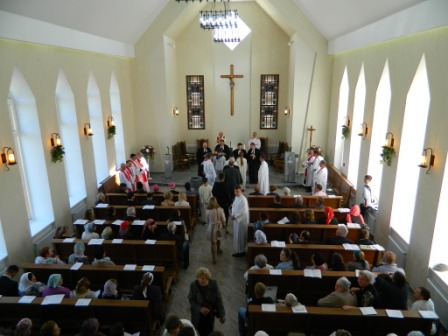
“It is a blessings and a large honor for me to be here as a guest,” said Irenues Lukas in Russian as he greeted the congregation in teh name of the Lutheran World Federation's 75 million Lutherans in 145 churches in 98 countries. “You are an important part of this family. While I am here for the first time as a guest, I am not a stranger among strangers. There is no doubt that this Church on a busy street will be not only be part of the beautiful architecture of the capital, but will also contribute significantly to the life of the country. As this church is opening I see two symbolic aspects – the Church will act as a living monument to the victims of repression and also as a new place of Reformation.”
In his sermon on the Good Samaritan Bishop Novgorod quoted the words “and see—we are alive” (2 Cor 6.9); this is also the name of the exhibition in the old church in Astana. “How does the story of the Good Samaritan relate to us? Of 2000 pastors in the Lutheran Church of the Russian Empire, by 1953 there were only thre left alive. In 1955 Evgeny Bachmann led a secret worship service. 90% of those who gave offerings for the building of our cathedral were Kazakhs, Muslims- Good Samaritans.” Bishop Novgorodov thanked the Lord for this happening, for the development of the country and the foundation of its stability, for inter-religious peace and agreement.
Then the chair of the Synod Council Pastor Zhanibek Batenov voiced the decision of the council from August 24: “the name of the newly dedicated Evangelical Lutheran Cathedral in Astana will be the Christ the Savior Cathedral.”
Archbishop Dietrich Brauer reminded those gathered of their common history as he presented the book “Five Centuries of Moscow Lutherans.” “Everything that took place was not not in vain. What seemed to be the end became a beginning. Evgeny Bachmann was able to get the congregation registered with the state after all the repressions.”
Bishop of Halle-Wittenberg and representative of Martin Luther Bund and the Gustav Adolf Foundation Johann Schneider presented an altar Bible with the wish that the Word of God will remain forever.
Dean Dirk Zauermann in his speech remarked that it would be impossible to build such a big church campus in such a short time in Germany; this new building was a real breakthrough.
For 23 years Hans Yakharov has made annual trips from Mecklenburg to Kazakhstan: “I am like part of the inventory of this church. Congregational members know me; I've listened to their stories, and I am thankful for these meetings. We have been connected with your church for more than 50 years; we have seen it's growth and strengthening.” He presented the first symbolic organ pipe for the future instrument that could be a part of the church.
At the end of the ceremony of dedication a folk choir gave a concert with German and Russian folk songs. Then all of the participants and guests could continue fellowship in front of the cathedral, take pictures and try out Kazakh food and fruits.


Monday, March 7, 2016

Lutherans in Kazakhstan Build Their First Church Building

Since 2003 the prayer house of the congregation in Astana has been located in a demolition zone. Constant changes in the economic situation means that the timing of this demolition is uncertain, but what is clear is that sooner or later the moment will come when the building will be torn down. In order not to end up without a home for the congregation they and the leadership of the Evangelical Lutheran Church in the Republic of Kazakhstan have decided not to wait the demolition notice, but to begin construction of a church.

The city set aside a lot for the construction in 2014. A building plan was made and submitted for inspection. In May 2015 the construction process began.
This is the first time Lutherans in Kazakhstan have had the opportunity to build an actually church building, rather than a prayer-house like construction. There will be two buildings on the church grounds - one will be the church itself, with a large and bright first half floor; there, according to plans, youth and diaconal ministries will be centered.
The other building will have 3 stories and will include: on the first floor - space for congregational work, Sunday school, the pastor's office and the library. On the 2nd floor - the Church administration, the archive and seminar rooms. On the 3rd floor there will be 8 2-person guest rooms will a small kitchen/dining room.
At present the ground floor of the church building is up, as are all three floors of the other building. The buildings are hooked up to electricity and work is being done on the plumbing. 
The structures are being built with the help of offerings from citizens and organizations in Kazakhstan, and we are very thankful to those companies that have helped: the "Astana" engineering center for the plans, the general contractor KazGerStroy," and the following building companies: the BIGroup, Alyansstroyinvest, Bazis, HeidelbergCementCentralAsia, Gornoe Buro, Zhambylskaya Cement Production Compnay, Strokonstruktsiya, Knauf, Funke-Kazakhstan, Astana Su Arnasy, Baly Mining, Akmola-Feniks, Geotek, Akpan, Iskander, KSPSteel, Ulmusbesshoky, Brick Factory #1 "15 years of Kazakhstan," Kaztsink. We thank as well the city of Astana, the Committee of Religious Affairs of Kazakhstan, and the Administrator of Religious Affairs of Astana.
We thank as well all the congregations of our Church, our ciricle of friends in Mecklenburg. We thank personally Albert Rau, Sergey Emirova and many, many others.
Kazakhstan is a surprising country, where around your Christmas table the majority might be Kazakhs. And at Muslim holidays in Kazakh homes around the traditional Central Asian tablecloth you will see representatives from the whole former Soviet Union - Russians, Ukrainians, Germans.. That's how we live. It is our heritage - we learned from our ancestors how to get along with and value our neighbors. 
And so they are helping us building our church, despite our differences in ethnicity and religion. And we are thankful to God and to our fellow countrymen.
Yuri Novgorodov, Bishop 

Monday, November 23, 2015

LWF President Visits the Church in Kazakhstan

Astana
  Bishop Munib Younan, President of the Lutheran World Federation, visited the church in Kazakhstan on June 11-12.  He shared his impressions through a LWF press release:
  “This was my first visit to Kazakhstan as LWF president. I learned a lot about the joys and challenges of the Kazakhstan Lutheran church. I explained our work together with the member churches: caring for refugees, advocacy for climate justice, women’s empowerment, theological reflections, ecumenical relations and inter-religious dialogue and so on,” Younan said.
  “Being in the communion means we are in pulpit and altar fellowship,” Younan said. “This means when I visit your Church I am at home with my sisters and brothers in Christ as we celebrate the Holy Communion that sends us together to the world with a call to holistic mission.”
  The conversations helped clarify the LWF’s role in the relationship with its member churches. “It was important to emphasize that the LWF as a communion of churches respects the autonomy of each church and that we accompany the churches upon invitation.”
  However, being churches in communion “also means that we are accountable to each other,” Younan remarked.


  Geographical isolation
The ELCRK’s core membership is made up of 2500 people in 50 congregations scattered across the country. The distance between congregations can be up to 3000 kilometers. The president saw his visit as an opportunity to learn firsthand the challenges of being geographically isolated.
Image  “I certainly felt how being far and in such a big country, and in another language context, can be a hindrance. I came to understand the difficulty of even gathering pastors to a national church meeting,” said Younan, who is bishop of the Evangelical Lutheran Church in Jordan and the Holy Land.
  Education and formation of pastors are key priorities of the ELCRK. The LWF president also heard the church’s excitement over plans to build a new church in Astana that will include a community center, youth services and guest house, and about its good relations with the government.
  Spirituality
But it was the church’s spirituality and deep piety that most struck the LWF president. “You have a certain spirituality in Kazakhstan; and I invite you to come to the table with your spirituality. It is an added value,” he said, referring to conversations with the pastors, and his church attendance.
“I suggested that they should be more involved in the life of the communion, including the Global Young Reformers’ Network, the women’s networks and other aspects of LWF,” he said. “This for me was a pastoral visit, and I let them know how important they are as part of the Lutheran communion.”
  Countering extremism
  Younan was in Astana also to participate in the international Congress of Leaders of World and Traditional Religions. At the gathering, he challenged the religious and political leaders to enhance their own engagement in fighting extremism and in peace building efforts.
  “Extremists exist in all religions. None has a monopoly on extremism. How do our speeches in the churches, mosques, temples reflect living together and co-existence? That is a challenge for us right now,” he noted.
  Younan emphasized his call to faith groups to examine the curricula they teach and offer their countries by asking: “Do we promote extremism or acceptance of the other that is different? Do we promote the concept of seeing the image of God in the other?”

Saturday, November 21, 2015

Council of Bishops of Union of Evangelical Lutheran Churches

Astana, Kazakhstan
  On April 21-23 in the capital of Kazakhstan, Astana, bishops from the former Soviet Union together with church administrator Marina Khudenko and EKD representative Michael Hubner met to discuss common issues and to sign a new version of their agreement on mutual cooperation. In addition the participants signed an agreement related to the spiritual care of congregations in Crimea. From now on three church bodies will have the right to work there – the German Evangelical Lutheran Church of Ukraine, the Evangelical Lutheran Church of European Russia and the Evangelical Lutheran Church in Bavaria. Congregations can now legally register in the Russian Federation and will be full members of the ELCER; they will also have the right to attend the meetings of the GELCU as guests with a voice, though without a vote. A third important decision was that all of the churches of the Union are given the right to independently join such international organizations as the LWF and the Conference of European Churches. It was also agreed upon that the question of the Union's membership in the World Council of Churches needs to be studied. Finally, the participants of the Union elected Yuri Novgorodov from Kazakhstan as the President of their council for the next two years.
  In addition to meetings the bishops took part in ecumenical meetings with representatives of the Roman Catholic and Orthodox churches and found time to talk and pray together about their brothers who were unable to attend – Otto Schaude and Corney Vibe.