Monday, January 1, 2018

Together with One Another and with Christ

Moscow
 From September 22-24 in the Sts. Peter and Paul Cathedral in Moscow a youth conference was held on the theme “Reformation: Yesterday, Today, Tomorrow,” dedicated to the 500th anniversary of the Reformation. More than 60 people took part from Lutheran congregations in Russia, Belarus, Kazakhstan, Kyrgyzstan, Georgia and Slovakia.

The main goal of the conference was to study the history of the Reformation together, to discuss the historical and theological nuances of the broad process. However the conference was not just a series of seminars, discussions and meetings – everything that is associated with the word “conference.” Instead young people created a comfortable, warm, you could even say home-like atmosphere in fellowship with one another.

The first day of the conference was dedicated to studying the past, the history of the Reformation itself. After prayer, the conference began its work. The question of the basis of Christian life was discussed – what is the foundation that a person builds his life on? Why is the question of a person’s relationship to God still relevant? Using skits young Christians took a creative approach to remembering those historical people who walked the path of Reformation, the path of a relationship with God. All the events of this day were mixed with energetic games that were in one way or another tied with questions of faith, Reformation and the service of God and one's neighbor. After supper there was a small excursion to the tourist sites near to the cathedral. Participants walked along the quiet, curvy streets and alleys of the Kitai-Gorod neighborhood and after supper even went on a Lutheran quest in the center of Moscow. The first day ended with a Taize prayer.

During the second day contemporary questions were raised - in particular how the Reformation as a spiritual transformation touches each of us. Participants shared with one another their visions of this issue, after which a skit prepared by the Lutheran congregation in Smolensk was performed in the chapel next to the cathedral. The name of the skit was “Martin Luther” and was dedicated to family values in the life of a Christian. Those in attendance noted the actors skills, in particular the person who played Martin Luther, whose character was portrayed very subtly and movingly. The second day ended with a prayer service led by the youth leader of the Moscow congregation, Vladislav Telegin and the preacher of the French-speaking congregation in Moscow, Mamy Rakotonitama, originally from Madagascar.

During the third and final day of the conference participants together with congregational members from the cathedral took part in Sunday worship during which the hymn of the conference (“God called us from various peoples”) was sung. Also during the second half of the day on Sunday there was an ecumenical youth worship service during with a number of participants took part together with representatives of other Protestant movements in Moscow.

During these days of work the participants also had the opportunity to spend their free time in an interesting way – some explored the city, others worked on crafts, others still played either board or sports-based games. The conference came to a close with a picnic in the yard of the cathedral.

All the participants could feel the spirit of true Christian unity, learn how congregations live in various parts of our country and neighboring countries, sharing with one another personal experience and cooperative work in various spheres of church life – from children’s ministry to to pastoral ministry. They expressed their desire to maintain their connections with one another and to work together on cooperative projects in the future. And there was even a note of melancholy  which participants felt in the last hours of the conference, but this could not destroy the joy that filled their heart and the thankfulness to the Lord they felt from the recognition of very simple and clear fact – we are the present and future of the church. We have seen each other face to face; we are together with one another and with Christ.

Natalia Shetsel, Vladimir Kazantsev


Crimea - 500th Anniversary of the Reformation Conference

Simferopol
The 500th Anniversary of the Reformation provided an opportunity for Lutherans around the world to return to the events of the early 16th century to see what lessons might be learned about theology, church life, and the role of Christians in society. We celebrated the many positive effects of the Reformation and we mourned its unintentional, negative consequences. In the context of the former Soviet Union, it was also a unique time to educate the wider public about who Lutherans are and the historic contributions of our church to the countries in which we live. Church leaders in the Evangelical Lutheran churches in the former Soviet Union took full advantage of the moment, with regular public events held both in central locations and throughout many far-flung regions of the church.
Typical for such conferences on a local level was one held in Crimea in September - “Lutherans in Crimea: History and Contemporary Situation.” Attending were students and teachers of the religious studies department of the state university, members of local Christian congregations and of Lutheran congregations from throughout Crimea, as well as local government officials. It was a joy to see this wide engagement and to attempt to answer the questions that were raised.
Papers were presented by guests, students, and local leaders, including pastor Sergei Matiukh and the lay preacher from the congregation in Simferopol, Maria Gusarova, who spoke about the contribution of Lutherans to the history of their region. Music from the 16th century helped set the tone of the day.
The conferences and ecumenical events held throughout the past year have done much to increase understanding of our church; when understanding increases, fear decreases and this is so important for helping people open up to consider their faith commitments. The challenge for the church now will be to maximize the positive effects of these public events in order to strengthen its ministry of spreading the message Christ's love to our neighbors.


Men's Ministry

Omsk
Getting men involved in our communities of faith has proven to be a challenge. It was a blessing, then, when early this fall fourteen men left their homes in cities as far west as Crimea and as far east as Krasnoyarsk in order to meet in Omsk for a seminar for leaders of men's ministry.

The theme of the seminar - “Brotherhood” - was highlighted by former ELCUSFE Bishop, Volker Sailer, during Bible studies. Area Dean for Siberia Vladimir Vinogradov put together an interesting program with practical and team-building exercises that not only were effective for the group, they also served as an example for what could be done in other locations. Together the men were able to open up about their experiences as disciples of Christ, as sons, husbands and fathers, and to support one another. As one of the participants put it, when they left they had a renewed sense that taking responsibility for the church's life is “not something that should be hoisted onto the shoulders of our mothers, grandmothers, and sisters;” it is important that men carry their share.

Restoring a sense of balance and of mutual responsibility will do much to improve the health of our congregations. We still have some way to go. Two of our aims with this seminar – that we would bring together those already highly experienced in the field and that we could bring in participants from other countries – went unrealized. We've decided to do one more push in this direction 2018 – we hope that in May more participants from the former USSR will be able to attend and that we can come together to work on a concrete program of activities that the leaders will then be able to replicate in their home regions.


Martin Luther's Small Cathecism translated into Azerbaijani

“Go therefore and make disciples of all nations, baptizing them in the name of the Father and of the Son and of the Holy Spirit” Mt. 28.19
This year Lutherans all over the world celebrate the 500th anniversary of the Reformation. Our congregation of the Savior in Baku also wanted to take part, and our contribution was the first ever translation and publication of Martin Luther's Small Catechism in Azerbaijani. Work on the translatio and preparation of the book began two years ago with the support of our American and Finnish friends. The State Committee for work with religious organizations approved its publication, and 250 copies were printed. Now brothers and sisters are able to get acquainted with basic Christian teachings in a short and clear form in their native Azeri language.
The translation of the Bible into German played an enormous role in the development of Christian life in that country, and we pray to God that it would play a similar role in ours. In the Church of the Savior in Baku we are thankful that we can now read the Bible, sing hymns and read the Small Catechism in our native language. After all only one's native language gives the person an opportunity to understand for oneself the richness of the Holy Scriptures, to believe in the one who is the Savior of the world. We need good Lutheran books in our native language so that pastors and congregations can freely teach, study, and understand.
I would like to express great thanks to our sponsors who continue the educational work of Martin Luther, especially the Lutheran Heritage Foundation (LHF) which has already published the Catechesis in more than 80 languages; a large part of the publication expenses was taken on by Concordia Publishing House. Thank you all very much, dear friends!
Pastor Menzer Ismailova

Family Camp in Crimea

Kurotnoe

From August 28 to September 1 in the village of Kurotnoe a family camp was held for the first time in our church in Crimea. The theme of the camp was “Who is this that the wind and the sea listen to him?” (Mk 4.41) It was held thanks to the initiative of the regional committee of Evangelical Lutheran congregations of Crimea. The organizer of the event was the “Liebe”congregation in Feodosiya with the assistance of the administration of the Evangelical Lutheran Church of European Russia.
Parents with children from Crimea were participants of the camp; guests came from Kazan, Krasnodar and Ulyanovsk. The Provorov family led the Bible lessons. Pastor Vladimir explored a new theme every morning: Noah, the Exodus, Jonah, the promise of the large catch of fish. At the closing service with Holy Communion the theme was “What is to be done?” During discussions of each theme the pastor spoke about the significance and importance of our faith.
Parallel with Bible studies for adults there were also Bible studies for children; Alena Provorova lead such interesting lessons that not only our children took part, but those who were at the campgrounds for other reasons also really enjoyed participating. Some of the adults, too, were “accidently” late to the adult meetings because they were so caught up in the stories being told for children.
The Lord blessed these days with good weather, a warm and clean sea and wonderful fellowship. The church council of “Liebe” plans to continue holding these family camps annually.

Irina Graf

The Rebirth of the Evangelical Lutheran Congregation of the Savior in Baku

Azərbaycan Yevangelik Lüteran Kilsəsinin. That is what “the Evangelical Lutheran Church of the Savior” looks like in Azerbaijani.

The first Lutheran church in Baku was established in 1853 and liquidated in 1936. The rebirth of the congregation began thanks to the active work of the former church council president, Tamara Gumbatova, in 1993. The congregation was officially registered on November 2, 1994. The main group of the congregation at that time were those Lutherans who were baptized and confirmed before the congregation's liquidation. The first spiritual leader of the congregation was Pastor Stefan Reder who visited the congregation from St. Petersburg from time to time. Afterwards other visiting pastors came from Germany thanks to Pastr Reder’s efforts.
In 1996 the congregation held an event at the Azerbaijan-Germany Society dedicated to the 450 anniversary of Martin Luther's death. Besides academic papers being read, there also was an exhibition - “Lutherans in Azerbaijan.” In 1997 at Easter 8 children were baptized, and in 1998 – 8 adults. This was a great joy.
The congregation waited a long time for a pastor who would come for a significant period of time; this person was Guenther Oborsky (1998-1998). On March 13-14, 1999, the congregation celebrated its 100th anniversary. Worship was led by the ELCROS Archbishop Georg Kretschmar and assisted by Stefan Reder and pastors of the congregation; there were many guests, including the German ambassador, a representative from the government's religious affairs office, and the Bishop Alexander of the local diocese of the Russian Orthodox Church.
After three years of pastoral vacancy, other pastors came as visitors from 2002-2007.
At present the congregation has 83 members (80% of which are women). The government office for religious affairs helped the congregation to get a space for worship in the historical "kirche," which presently is home to the chamber and organ music hall.
According to the agreement with the State Philharmonic signed June 26,2011, the Lutheran congregation in Baku received the right to have worship in the sanctuary of the church and use the wonderful organ for that purpose. Despite many years of effort, the congregation is not able to get the building back as its own possession, and it even has to pay rent for using the space for worship. Everything else the congregation has to do in the “office,” a sizable apartment in the city center...but rent for it needs to be paid, too.
In 1996 a law was passed in Azerbaijan forbidding foreign missionaries to work in the country, so it was a great gift for the congregation that Menzer Ismailova studied at the Theological Seminary in Novosaratovka and came back to serve as its pastor in 2011.
Today the congregation of the Savior in Baku is part of the Evangelical Lutheran Church in Georgia and the Southern Caucasus (ELCG); twice a year its representatives take part in the ELCG's synods. We are united by much: our liturgy for worship, common events and seminars, the sharing of mutual experiences. It is worth noting that the bishops of ELCG have constantly supported us – Dr. H.Hummel, Dr. A. Shoekel, Dr. J.Launhardt, and Hans-Joachim Kiderlen.
History and the present situation point to the fact that the Lutherans of the southern Caucasus were, are, and will remain a united whole.
Vera Nesterova and Natalia Bairamova

A New Church for Lutherans in Kazakhstan – the Church of Christ the Savior has been dedicated!

Astana

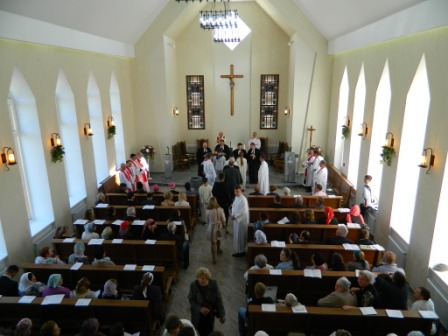
On September 17 congratulations rang out for the Lutherans of Kazakhstan who, for the first time in their century and a half history, have built and dedicated a new church building.
Among those taking part in the celebration: the Archbishop of the Evangelical Lutheran Church of Russia Dietrich Brauer, the Bishop of the German Evangelical Lutheran Church of Ukraine Sergei Mashevskii, representatives of the Circle of Friends of Kazakhstan from Mecklenburg Hans-Heinrich Yarkhov and Waldemar Henrich Zabilny, the representative of the Martin Luther Bund and the Gustav Adolf Foundation the Bishop of Halle-Wittenberg Johann Schneider, the representative of the Lutheran World Federation for Europe, Ireneus Lukas, the representative of the Evangelical Lutheran Church in Northern Germany Dean Parchima in the region of Mecklenburg Pastor Dirk Zauermann, the representative of the Evangelical Church of the Augsburg Confession in Romania Pastor Uve Zaidner, pastors, deacons, members of Lutheran congregations in Kazakhstan, sponsors of the building process.
At the ceremony of dedication representatives of the government were present – the minister of religious affairs and civil society, representatives of the akimat, the committee for religious affairs, parlament, embassies of Germany and Sweden, the Orthodox Church and the Catholic Church.
The new church complex is made up of the cathedral and the church center.  The building process began in June of 2015 and was fininshed in only 2 years and 2 months.  “It was necessary to take this step” said Albert Rau, the sponsor of the building of the cathedral as he stood by the church gate. “We thank the akimat of the city for their help in providing a property on which to build, and we thank the people of various nationalities and denominations that have given offerings both of money and also of building materials: cement, tiles, bricks. In order for our church to have a future, it needs the right conditions for working with congregational members.”
Bishop Yuri Novgorodov broke tradition a bit by inviting infants to be the first to enter the building.
“It is a blessings and a large honor for me to be here as a guest,” said Irenues Lukas in Russian as he greeted the congregation in teh name of the Lutheran World Federation's 75 million Lutherans in 145 churches in 98 countries. “You are an important part of this family. While I am here for the first time as a guest, I am not a stranger among strangers. There is no doubt that this Church on a busy street will be not only be part of the beautiful architecture of the capital, but will also contribute significantly to the life of the country. As this church is opening I see two symbolic aspects – the Church will act as a living monument to the victims of repression and also as a new place of Reformation.”
In his sermon on the Good Samaritan Bishop Novgorod quoted the words “and see—we are alive” (2 Cor 6.9); this is also the name of the exhibition in the old church in Astana. “How does the story of the Good Samaritan relate to us? Of 2000 pastors in the Lutheran Church of the Russian Empire, by 1953 there were only thre left alive. In 1955 Evgeny Bachmann led a secret worship service. 90% of those who gave offerings for the building of our cathedral were Kazakhs, Muslims- Good Samaritans.” Bishop Novgorodov thanked the Lord for this happening, for the development of the country and the foundation of its stability, for inter-religious peace and agreement.
Then the chair of the Synod Council Pastor Zhanibek Batenov voiced the decision of the council from August 24: “the name of the newly dedicated Evangelical Lutheran Cathedral in Astana will be the Christ the Savior Cathedral.”
Archbishop Dietrich Brauer reminded those gathered of their common history as he presented the book “Five Centuries of Moscow Lutherans.” “Everything that took place was not not in vain. What seemed to be the end became a beginning. Evgeny Bachmann was able to get the congregation registered with the state after all the repressions.”
Bishop of Halle-Wittenberg and representative of Martin Luther Bund and the Gustav Adolf Foundation Johann Schneider presented an altar Bible with the wish that the Word of God will remain forever.
Dean Dirk Zauermann in his speech remarked that it would be impossible to build such a big church campus in such a short time in Germany; this new building was a real breakthrough.
For 23 years Hans Yakharov has made annual trips from Mecklenburg to Kazakhstan: “I am like part of the inventory of this church. Congregational members know me; I've listened to their stories, and I am thankful for these meetings. We have been connected with your church for more than 50 years; we have seen it's growth and strengthening.” He presented the first symbolic organ pipe for the future instrument that could be a part of the church.
At the end of the ceremony of dedication a folk choir gave a concert with German and Russian folk songs. Then all of the participants and guests could continue fellowship in front of the cathedral, take pictures and try out Kazakh food and fruits.