Friday, February 5, 2016

150th Anniversary of St. George Сhurch in Samara

Samara
On September 13th guests (local and from among partners in Stuttgart) and congregational members gathered together in St. George church for a special event - the 150th anniversary of the church's dedication, which took place on September 26, 1865.

But that wasn't the only reason to come together for celebration - it was also the 200th birthday of the Governor of the Samara region, Constantine Karlovich Grot, the founder of St. George congregation. While the church choir sang the oldest member of the congregation, lay preacher Andrey Dubitsky, dedicated the Grot memorial plaque with the following quote from the Bible as a message to the citizens of Samara: "But seek the welfare of the city where I have sent you into exile, and pray to the LORD on its behalf, for in its welfare you will find your welfare." 
The Minister of Culture of the Samara Oblast Sergei Filippov said that the church and the congregation are important elements of the makeup of the city and the region. The representative from the city administration wished the congregation well, and then a representative from Stuttgart's government, Isabel Fezler, passed on greetings (in Russian! This was a pleasant surprise) as well. Pastor Olga Temirbulatova gave Ms. Fezler grapes from the vine they planted together in 2012.
The Orthodox priest Father Vitaly, a long-time friend of St. George Church, emphasized the current cooperation between the Orthodox Church in Samara and St. George church in the area of diaconal work. It was also a joy to hear the words of greeting from Pastor Viktor Ryaguzov from the Baptist church. The congregation in Tolyatti gave as a gift an angel (made by children with developmental disabilities). The children also participated in the worship service. After worship there was a small concert by organist Kye Johannsen. Although there were only a few songs played, those who listened were able to enjoy the wonderful music of a professional who loves his instrument. 
The celebrations came to an end after tea time, during which congregational members and guests shared their impressions. Afterwards many people went to the Volga embankment to join in the city-wide celebrations of Samara's city day. 
 Anna Gamazina


Thursday, February 4, 2016

Celebratory Days in Sarepta

Volgograd
From September 18-20 the Lutheran congregation in Volgograd celebrated a triple anniversary - 250 years from the moment of the founding of the only colony of the Moravian Brotherhood in Russia - "Sarepta;" 25 years from the moment of the rebirth of the Lutheran congregation in Volgograd and 10 years since the organ was installed in the church. The congregation as well as the local community organization the "Center of German Culture" and the "Old Sarepta" historical museum took part in the celebrations.
There were many guests from near and far at the celebration. Honored guests who gave their greetings included: ELC Archbishop Dietrich Brauer, Pastor Dietrich Hallmann and his wife Dorotea, who served in the congregation from 2000 to 2006, Karla Langerfeld - a pastor descended from a line of Moravian pastors in the 7th generation, partners of the German cultural center from city of Fuld (Germany), a representative of the International Union of German Culture, a representative of the German embassy in Moscow, the Minister of Culture in the Volgograd Oblast and the Vice-Chair of the Government of the Volgograd Oblast. 
Other congregations in the Lower Volga Deanery also took part - Kamyshin, Elista and the village of Lebyazhiy.
The event was opened by the laying of a time capsule with wishes of peace and good will to those who will open it 50 years from now. Two descendants of the Sarepta colony lead this memorable event.
On September 19th the Pastor of the congregation Oleg Schtulberg was married in the church with his wife Tatyana; the wedding was officiated by Pastor Dietrich Hallmann. 
On a sunny Sunday morning members of the congregation and guests gathered for worship, where Archbishop Dietrich Brauer preached. He also took part in the celebratory events related to the anniversary of Sarepta.
Finally in these days there was a meeting of the deanery with partners from the Berlin Mission.
Tatyana Schtulberg


Theology Conference - "Man in the Age of Apocalypse"


St. Petersburg
An ecumenical theological conference titled "Man in the Age of Apocalypse" was held in Petrikirche on September 26.
Taking part in the conference were: Michael Schwartzkopf, dean of the Northwest Deanery of the ELCER, Archpriest Vladimir Fydorov of the Prince Vladimir Orthodox Cathedral, President of the Theological Seminary of the ELC Anton Tikhomirov, priest and teacher at the Roman Catholic seminary Alejandro Jose Karbaho Olea, deacon of the Evangelical Lutheran Church of Ingria Evgeny Mikhailov and teacher of religious studies at RGPU Alexei Gaidkov. The moderator of the seminar was the church council president at St. Catherine's Lutheran Church, Elvira Zheids. 
Among the topics discussed were: faith a demagogry, religion and ideology, the sources of inter-cultural and religious conflicts, finding paths for dialogue between believers and non-believers and the opportunities offered by pluralism. 
Pastor Anton Tikhomirov spoke about his experience teaching in a Lutheran congregation in Kazakhstan: "I see the main task of the church on the whole and this seminar in particular to be to make connections with the people who are around us," he said. "My recent experience in leading a seminar in Astana among conservative-minded people showed that themes of eschatology are particularly controversial. Of all the theological disciplines, in questions of eschatology there is the least amount of theological clarity. Discussions with participants of the seminar showed how deep the filters or lens sit within us that we use while reading the Gospel; they do not allow us to see that which lies beyond that narrow field of vision which we have created for ourselves. It is quite common to find an inability or very slight ability to take on a new point of view. I came to the conclusions that we need to develop language both outside and inside the Church for reaching other people with what we really think. There are huge barriers here: priests in the church frequently speak in only in "church dialect," using concepts that are understandable only to those on the inside - grace, salvation, following Christ and others; these things don't mean anything for someone outside of the church. All the same we understand this barrier and try to overcome it. The second is more difficult and it is related to the expectations of people outside of the church. They expect us to speak in religious jargon. I've very often met people who are capable of interpreting philosophical texts, prose or poetry in a free and creative way, but as soon as they run in to religious texts them become like stone statues. In other words for most people religion is a selection of dogmas that cannot be put aside even one bit. How do we teach people that faith, theology, religion - these are also spheres of creativity, freedom and thought for which there are no firmly fixed borders - that's the biggest problem. We should work in this direction."
Archpriest Vladimir Fyodor noted that the main question for the contemporary Church is what language the clergy speaks in, what people hear from them, and what they understand. Theology isn't like math or other exact sciences - it is not about definitions, but about images, since theology is figurative thinking. "We try to describe a mystery and mathematical logic will not help us with this, only images. The description of a mystery should be in figurative language and then it will always be relevant," said Father Vladimir.  In his opinion the main tension that exists in society is not interconfessional, interreligious or conservative / liberal split, but it is between enlightenment and willful ignorance or "obscurantism." In Russian this word ("mrakobesie") points to a source in the demonic and in the dark. A person can be possessed by darkness. When there is no light, a person becomes insane. Enlightenment is a deeply Christian term - Christ enlightens us with the light of truth, ignites the light of reason. Revelation is possible only when there is light. In the fast few centuries this Christian understanding has been distorted by the rational approach that was dominant in the era of Enlightenment. The conflict between darkness and light exists within every confession; it is no surprise, then, that an Orthodox theologian understands a good Catholic priest almost immediately, while two Orthodox priests with different levels of education might consider one another to be heretics.  "Today it is very important to have the skill of reading holy texts since only through interpretation is something revealed. In the contemporary world there is not enough communication, not enough exchange of interpretations. A person who seeks the truth is seeking God whether he or she recognizes this or not. In order for there to be enlightenment, there needs to be the light of Christ. For me this light of Christ is the search for that language in which I can communication my religious experience. I am only able to communicate that which I know - my own internal experience," said Father Vladimir. 
The representative from the Roman Catholic Church priest Alejandro Jose Karbaho Olea told about how in his home country, Spain, the church was unable to find a suitable language for communicating with youth, and therefore the majority of the people of his generation and younger are lost for the church today.
The importance of the right kind of dialogue with the congregation was emphasized also by the deacon from the Evangelical Lutheran Church of Ingria, Evgeny Mikhailov. In his words the preacher, communicating with the congregation, to a certain extent answers the question he himself put forward and not always those which are interesting to people. 
"There are various levels of truth," said Father Alejandro, "the understanding of Revelation is different now then in the 13th century. The interpretation of truth changes with time." "Pluralism is good when it is a result of education, not the lack of education," added deacon Mikhailov. "It is good when there are many opinions if these opinions are of high quality."
The participants of the conference agreed that the main task of the clergy today is to seek for forms which can be used to reach people with the Gospel."
From materials from the "Water of Life" information agency. 


22nd Summer Seminar in the Far East Deanery - The Church as a Special Community in the World

Adapted from materials on the site of the Deanery of the Far East: luthvostok.com

This was a very special seminar. There were participants from each of our 9 congregations. There were 36 persons in attendance including 4 lecturers (Pastor Bradn Buerkle from St. Petersburg, Pastor Alexander Lapotschenko from Arsenyev, Preacher Nina Dimitrijewa and Pastor Manfred Brockmann from Vladivostok) and 8 guests who paid their own way. We were at the same beautiful place where we have held our Deanery seminars for many years. 
The main theme for this seminar was The Church. The seminar had four large units.
1) Bradn Buerkle showed us by walking us through the Bible in an impressive way that the people of God have always been a special community in this world.
2) Pastor Lapotschenko  showed us in a very interesting way how the church developed over the centuries. He named his unit “The Tree of the Church” and that was a very fitting title. He said there is one root, Jesus Christ, from this root a tree has grown with many different branches.
3) But there are so many problems and conflicts in the church. This was the topic for Pastor Bradn Buerkle’s unit entitled, “Conflicts--How To Live with Them and Overcome Them” This topic was understandably of interest to our participants, because who doesn’t have lots of problems in their lives!
4) Another relevant unit came from Dean Brockmann, who told about his trip that just happened in June. This was a trip to visit our American partner churches in the Central States Synod. He also talked about the brotherhood and unity of the Christian Church that transcends cultural and international borders. These many partnerships with churches of our deanery with churches in America must be revitalized anew. Dean Brockmann put the words of the new Bishop of the Central States Synod on the blackboard: “Our society is so loud, that it is becoming harder and harder to hear the quiet voice of God. ” It was necessary to announce this statement because some people were making such a racket with their radios and laptops and this was happening at a place of solitude, without any television or radio.
There was further focus during the seminar on the following:
--The unity of “Paul and Christ. Who is close to Jesus Christ?” Dean Brockmann worked with us on this topic. Paul never saw the historical Jesus but in spite of that he became his greatest Apostle. He saw the risen Christ. And that is still possible today. This was made clear to us based on the essay by Alexander Menh, “Encounters with the Risen Christ.” After all, whoever is baptized, lives in Christ (Romans 6:3; Galatians 3:27) and Christ lives in them, (Galatians 2:20). The greatest task and passion for the Christian in this life is to know Christ more and more.
--This was followed by a unit taught by our Nina Dmitrijewa. She spoke to us about the theme for the World Day of Prayer for 2016. She conducted a Bible study using Mark 9:37 and about the themes of “Faith, Love and Hope.”
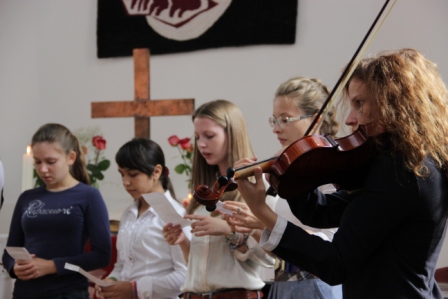
---Music had a special meaning for us. We had some very talented people and among them was Tatyana Filobok from St. John’s Church in Chabaroffsk. She led our group singing and the group was accompanied by Nadjeschda on the violin and Manfred Brockmann on the viola. Everyone really got involved and Bradn Buerkle commented afterwards: “That was the highlight of our seminar.” 
There was of course a large Council Meeting of the Deanery, in which all of the congregations had their say.
Our biggest problems are -the St. Mark’s congregation in Magadan, which still hasn’t been able to find renters for the rooms in their congregational building and --the St. Matthew’s Church in Tschita, which is in desperate need of a pastor and also needs a congregational building. There are some unbelievable people serving this congregation! --Some very happy news was reported from St. Luke’s in Arsenyev. Their faithful partner congregation, Trinity Lutheran in Great Bend gave them some very generous help. St. Luke’s is not going to hire a firm for the addition to their church building. Instead they are going to do all the work themselves. The entire congregation is joining together to do this. That is because the right people got the money!
We then had an evaluation of the seminar. There were a variety of responses. - Oleg said, “I recovered quite well. (Why wouldn’t you).-- Ludmilla P. said “Especially good units by Bradn Buerkle, Nina Dmitrijewa and Manfred Brockmann , and she also said “The next time we will need to choose our participants more carefully.” ( Yes!). Tatyana Filobok said, ”Thank you to everyone, but special thanks to Manfred Brockmann for organizing these seminars. (This recognition was well received by him.), but also to quiet, faithful Edik, even though he couldn’t prevent three bus mishaps. We are all such different people.” --Olga Linker said (photo) “Everything was so good. We would like to see something like this again, with the children present.”-- Ekatarina Weitz.said, “Thanks. Everything was so nice especially the sea. We were so happy.” --Nina Dmitrieva said, “Thank you all so much that you all listened to me when I spoke. I would like to communicate, what I know” -- Svetlana Mik said, “I haven’t been here for two years. It is so good for me to get together with my brothers and sisters from far away.”


Wednesday, February 3, 2016

Archbishop Brauer Visits Khakasia


Abakan, Russia
  On July 26th  congregations of Khakasia and the southern part of the Krasnoyarsk region gathered for a special worship service in Abakan, lead by Archbishop Dietrich Brauer and accompanied by the administrator of the ELCER and native to Abakan, Viktor Weber.
  The visit to the region was tied with the congregation's 15th anniversary. The congregation was founded thanks to the efforts of German missionaries from the ELM in Hermannsburg who at first gathered together local Russian Germans who wanted to know about their religious roots. Despite emigration to Germany, the congregation has grown throughout the years thanks to families being involved in the church and passing their faith on, as well as a result of new members joining the congregation.
Archbishop Brauer reminded the congregations that Christians are called to be the “salt of the earth and light to the world,” i.e., to be an example of right living for others and to work for the peaceful co-existence of all peoples.
Bishop Brauer, Pastor Weber and the chair of a government office passed on their congratulations and gifts to the congregation. Also the congregation itself recognized some of its members for their long-time contributions to the development of the church.
 After worship in Abakan Pastor Dimitry Schweitz gave a presentation on the six congregations in the region. Later there was worship in the prayer house in the village of Bograd, where the guests learned about the history of that congregation, which reaches back to the time of the resettlement of Russian Germans to the region in the 1950s.
  The visit of the Archbishop was a joy for the congregations, and they expressed their thanks to him for his interest in their life and ministry.


Seminar in Sarepta

Volgograd
  “About Us and Our Church,” a seminar that ran from May 8th to the 10th on the site of the congregation in the Sarepta neighborhood of Volgograd, was the beginning of a project supported by the Berlin Mission and Bread for the World. The idea of this project is that Sarepta can become an additional site for education for church staff in the Volga region. The project is planned for two years; during this time there will be seminars and pastors' meetings. This first seminar, led by members of the Volga region working group in the Berlin Mission and a member of the Gustav Adolf Fund in Berlin, focused on the discussion of how to best plan educational efforts in the region in the next two years. Pastors and preachers from around the Lower Volga Deanery took part, including Dean Oleg Stulberg.


The Restoration of the Kirche in Marx

 At the beginning of August as the city was preparing to celebrate its 250th anniversary, the Lutheran church in Marx (Saratov region) had almost regained its original form. Built as a church on the central town square, it was turned into a “house of culture” during Soviet times; now it is a church again, with a new tower and bell.
  The congregation in Marx, then Marxstadt, was closed exactly 85 years ago, on the 5th of August 1930. In 1941 its cross was removed, and the clock on the tower stopped working. It is said that someone took home the keys to the clock, waiting for a time when the Russian Germans, exiled to Siberia by Stalin, could return. Unfortunately, the bell tower was destroyed long before that could occur. The excuse for taking down the tower was that some boys had climbed up it chasing pigeons, and one of them fell. This might have been the case, but the real reason for its destruction was that the tower of the former Lutheran church, located just across the street from the Communist Party headquarters, irritated local officials. Long-time local residents say that those few Germans who had escaped deportation stayed home and prayed in quiet on the day the tower was torn down, while Russian women who walked by had angry words for those doing the destruction – it might not have been their church, but it was a church nonetheless, and they knew that it was wrong to destroy it.
  The building hosted the town's only cultural events in the Soviet period, but in the 1990s it changed hands a number of times before it was finally returned to the Lutheran congregation for its use. It is not the church's own property yet, though, and that is a matter of time and money. It is a huge building and the congregation, even though there are around 300 people there for worship on Christmas, the congregation still cannot maintain a building that was meant for 3000.  Yet a local sponsor, Vitkor Schmidt from Saratov, is doing a lot to restore the building. For now the congregation is grateful for the cross that acts as a sign and even beacon of faith for all who live in the city.